“The Editor” by Jennifer Lindsay
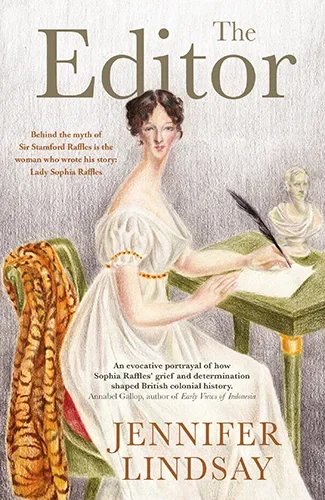
In this article for the Asian Review of Books, Rosie Milne writes a review for The Editor, a novel by Jennifer Lindsay about Lady Sophia Raffles’s journey in writing a memoir for her late husband Sir Thomas Raffles.
In 1819, Singapore came under the control of the English East India Company, under murky circumstances involving its rivalrous local officials acting without authority from London, exploiting divisions amongst the existing royal family, and ignoring claims that the island fell within the Dutch sphere of influence. Whichever version of history one believes, it is clear that Sir Thomas Raffles played a very large part in the founding of Singapore as a British colony: for most of the last two centuries he has been remembered as its sole founder. Why? After his death, his widow, Lady Sophia Raffles, compiled Memoir of the Life and Public Services of Sir Thomas Stamford Raffles.
Sophia intended the Memoir as a political defence of her late husband; she wanted to clear his name of charges of corruption and insubordination laid by his rivals, and to have the foundation of Singapore credited entirely to him. The Memoir was well-received; it laid the groundwork for Raffles’s subsequent veneration as a hero of the British Empire.
Jennifer Lindsay, an award-winning translator from Indonesia into English, as well as an editor, essayist and columnist, has novelised this in her debut The Editor. Her novel follows Sophia, who referred to herself throughout the Memoir, as “the editor”, as she struggles to compile the memoir she’s editing. It opens with Raffles’s death, in 1826, and closes with Sophia holding a printed copy of her book, in 1830. In the four years between, she has surmounted doubt that she’s up to the task of producing any memoir at all, faced painful truths and even more painful memories. overcome the temptation to give up her editorial work, been harassed for money by mean-spirited officials and come to a new understanding of her husband, her marriage and herself.
If The Editor is partly about a widow using her late husband’s life as a path to finding out about her own, it is also an exploration of questions about who gets to make history and why, and about the relationships between biography, fiction and truth.