“Murni Top-Down”: A Look at Prabowo’s Village Cooperatives
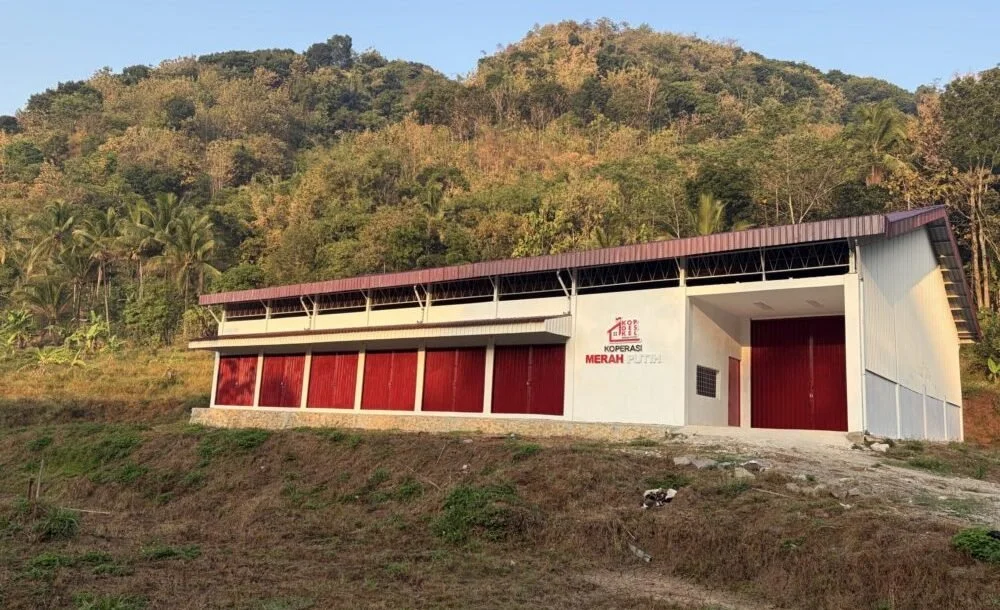
Red and white cooperatives are situated wherever the village can spare land—in this case, on the edge of a rubber plantation. Image altered to remove details identifying location | Photo: Jeff Neilson
In an article published by New Mandala, Jeff Nielson writes about Prabowo’s “Red and White” village cooperatives. He asserts that the village cooperatives program is struggling to justify its own existence in the eyes of the communities it’s supposed to support.
Drive almost anywhere in rural Indonesia now and it’s hard to miss them: prominent red-and-white buildings, based on a uniform 30 by 20 metre layout, all with the same centrally-designed features and deposited on whatever land the village administration was willing to hand over. Some sit isolated near forests or fields, whilst others have been squeezed into village hall forecourts so that staff grumble about picking their way around the building to reach their office. Where a main road happens to run along the boundary between two adjacent villages, I have seen two of these buildings located within a few hundred metres of each other, each to be fully equipped, both serving what is functionally a single, undivided catchment.
The Red and White Village Cooperatives (Koperasi Desa Merah Putih, KDMP) program has become the most visible feature of the Indonesian rural landscape under President Prabowo Subianto. According to the Ministry of Cooperatives, as of July 2026 15,845 KDMP had already been built and a further 19,539 were under construction. The program aims to build some 80,000 such cooperatives—one in every village across the entire country. On a recent trip to Indonesia, I stopped by at a few KDMP in Wonogiri (Central Java) and North Toraja (South Sulawesi) to talk to villagers and find out what is going on inside them and what purpose they are supposed to serve.
The first thing you realise immediately is that these so-called cooperatives cannot really be considered cooperatives in any meaningful sense. The birth of Indonesia’s cooperative movement is widely associated with Mohammad Hatta, the country’s first (and much-loved) vice-president, who envisioned cooperatives as vehicles for member-owned, democratically-governed, economic self-determination based on voluntary participation.
I suspect, however, that Hatta would be astonished at what is now being built in the movement’s name: a network of buildings, constructed and operated by a state-owned enterprise, some with brand new vehicles imported from abroad, and with operational directives sent from Jakarta and supervised and monitored by territorial military officers. One Village Head (Kepala Desa) I met was waiting for technical guidance on what economic activities the KDMP should pursue and how it would operate. I suggested to him that the program seemed a little top-down. He responded bluntly without hesitating: “oh, murni top-down (purely top-down)”.