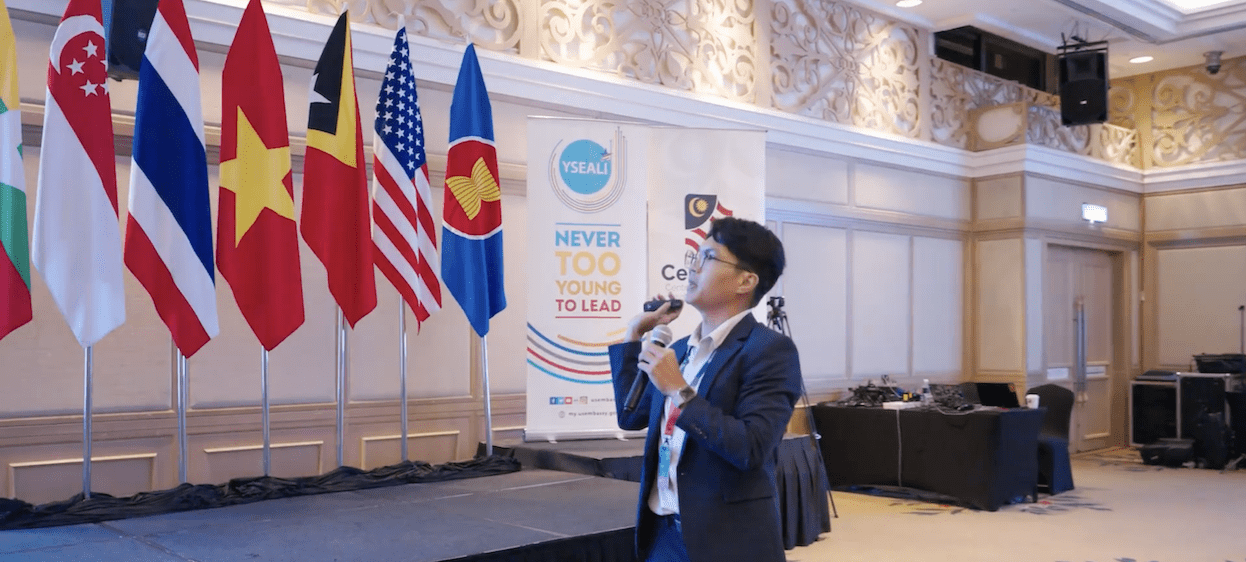
A speaker at the Young Southeast Asian Leaders Initiative (YSEALI) 2025 summit in Penang, Malaysia | Screengrab from Biji-biji Initiative / Youtube
In this Fulcrum article, Hoang Thi Ha and Eugene R.L. Tan assert that the United States’ human and intellectual connections to Southeast Asia are gradually being undermined.
Southeast Asia’s experience thus far with the second Trump administration could be characterised as whiplash, from the closure of the US Agency for International Development (USAID) and tariff spikes to soaring fuel prices due to the ongoing Iran conflict. Beyond the bluster and bombast, a quieter but equally significant erosion is underway: the hollowing out of America’s human and intellectual connections to Southeast Asia that long underpin US influence in the region.
The erosion starts with America’s knowledge of the region. Area studies in the US trace their origins to the post-World War II period, when they were embedded in the broader national security imperative through the 1958 National Defense Education Act. Consequently, Title VI of the 1965 Higher Education Act established government funding for National Resource Centres (NRCs) focusing on foreign language and area studies (FLAS). Successive US administrations had subsequently invested in building a deep reservoir of regional expertise, supporting language training and academic research on Southeast Asia across eight American universities.
That foundation is now being dismantled. The Trump administration’s termination of USD60 million federal funding for Title VI NRCs and FLAS fellowships has had immediate consequences. In terms of NRCs and language grants for the 2025–26 academic year, the universities of Washington have lost USD2.5 million, Michigan USD3.4 million and Kansas USD2 million. Together, they are homes to well-established Southeast Asian and East Asian studies centres.