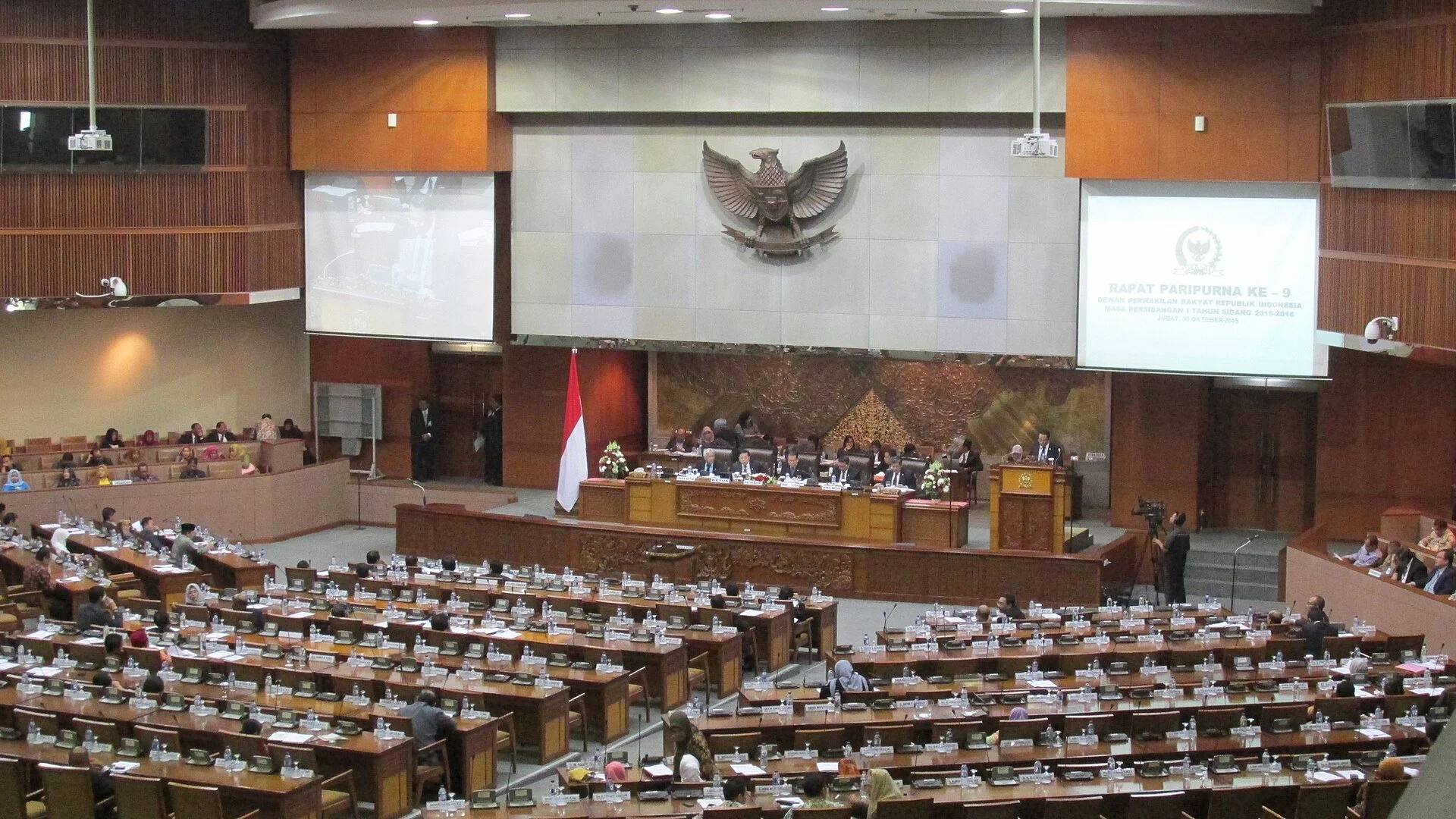
People’s Representative Council of Indonesia | Photo by Andylala Waluyo, Public Domain
In this essay from Tracking the Next Generation of Leaders in South and Southeast Asia published by The National Bureau of Asian Research, M. Waffaa Kharisma asserts that Indonesia’s next generation of political leaders and their views on foreign politics will be increasingly defined by a growing acceptance of the need for strategic resilience and autonomy in a volatile global order.
Indonesia enters the mid-2020s in a position that is less familiar in its reform era. The country faces a high degree of domestic political consolidation, at least at the elite level, combined with external strategic uncertainty. Domestically, the political landscape under President Prabowo Subianto’s administration is characterized by a large governing coalition and weak and fragmented opposition forces.[1] Internationally, Indonesia faces a global environment marked by intensifying U.S.-China strategic competition, growing skepticism toward the credibility of the rules-based international order, and the increasing salience of economic and technological dependencies.
Indonesia’s foreign policy identity did not emerge in a vacuum. Rooted in the 1945 constitution’s commitment to world peace and social justice, it was given strategic form by Vice President Mohammad Hatta’s foundational articulation of a “free and active” foreign policy, an approach that rejected not passive neutrality but the false choice between great power blocs.[2] For Hatta, Indonesia was to navigate international waters like a boat rowing between two reefs—not by avoiding movement but by using national interest and principle as a compass, continuously navigating without condemning itself to permanent alignment with any single power. This vision was reinforced by the anti-imperialism of Indonesia’s first president, Sukarno—the conviction that external great powers posed existential threats to the sovereign self-determination of young postcolonial nations—and institutionalized by Indonesia’s second president, Suharto, who developed national resilience as a comprehensive security doctrine and cofounded the Association of Southeast Asian Nations (ASEAN). ASEAN’s norms of noninterference, consensus, and sovereign equality were designed in part to insulate smaller states from great-power coercion and provide Indonesia with a regional platform to project its preferences without triggering external backlash.[3] Together, these strands produced a durable normative tradition: one in which multilateralism, international law, and principled nonalignment were not diplomatic luxuries but instruments of sovereignty preservation for a large, resource-rich archipelago navigating an asymmetric world.