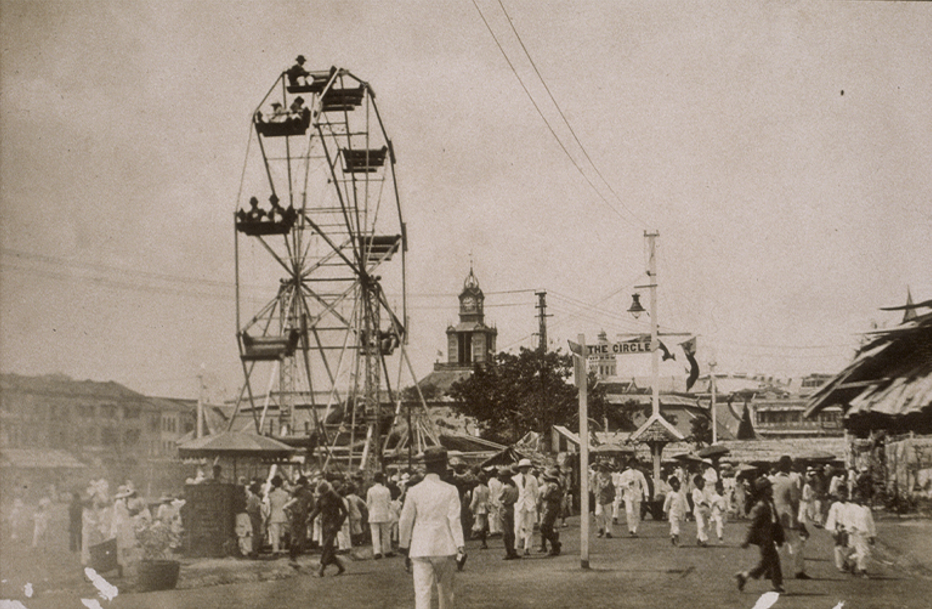
The Malaya-Borneo Exhibition Carnival in Singapore, March-April 1922 (Photo: National Archives of Singapore)
In this article for New Mandala, Teuku Reza Fadeli writes about the history of Southeast Asians navigating colonial consumer spaces by examining colonial newspapers, fair catalogues, and advertising archives from Surabaya, Penang, and Singapore.
In Southeast Asia today, consumer choices are becoming increasingly linked to questions of identity, heritage, and even political expression. This connection, however, is not new. Its roots extend to the 1920s and 1930s, when colonial cities such as Surabaya, Penang, and Singapore saw the rapid growth of department stores, fairs, shopping arcades, advertisements, and branded goods. Colonial officials and European firms often presented these spaces as evidence of Western progress, yet they were never fully controlled by colonial designs: Southeast Asian consumers, traders, journalists, and organisers used the same spaces to negotiate identity, assert status, defend local enterprise, and criticise foreign economic dominance.
Historical narratives of anti-colonialism have often focused on parties, nationalist organisations, and formal political struggles. My doctoral research examines a more everyday arena: the participation of Southeast Asians in consumer culture. Some ordinary practices acquired political meaning: supporting local goods and participating in boycotts could become explicit forms of economic protest, while fashion, advertising, and the use of traditional motifs allowed consumers and businesses to negotiate colonial ideas of taste, status, and modernity.
Colonial consumer culture did not produce a single political outcome. It was designed to attach modernity to Western goods, spaces, and habits, but Southeast Asian consumers, traders, journalists, and organisers often redirected these meanings. Some did so through boycotts and local goods campaigns; others through fashion, advertising, craft promotion, or moral criticism. These practices did not always amount to formal anti-colonial resistance, but nonetheless reveal how everyday consumption became a field in which colonial authority, class aspiration, cultural identity, and political mobilisation met.