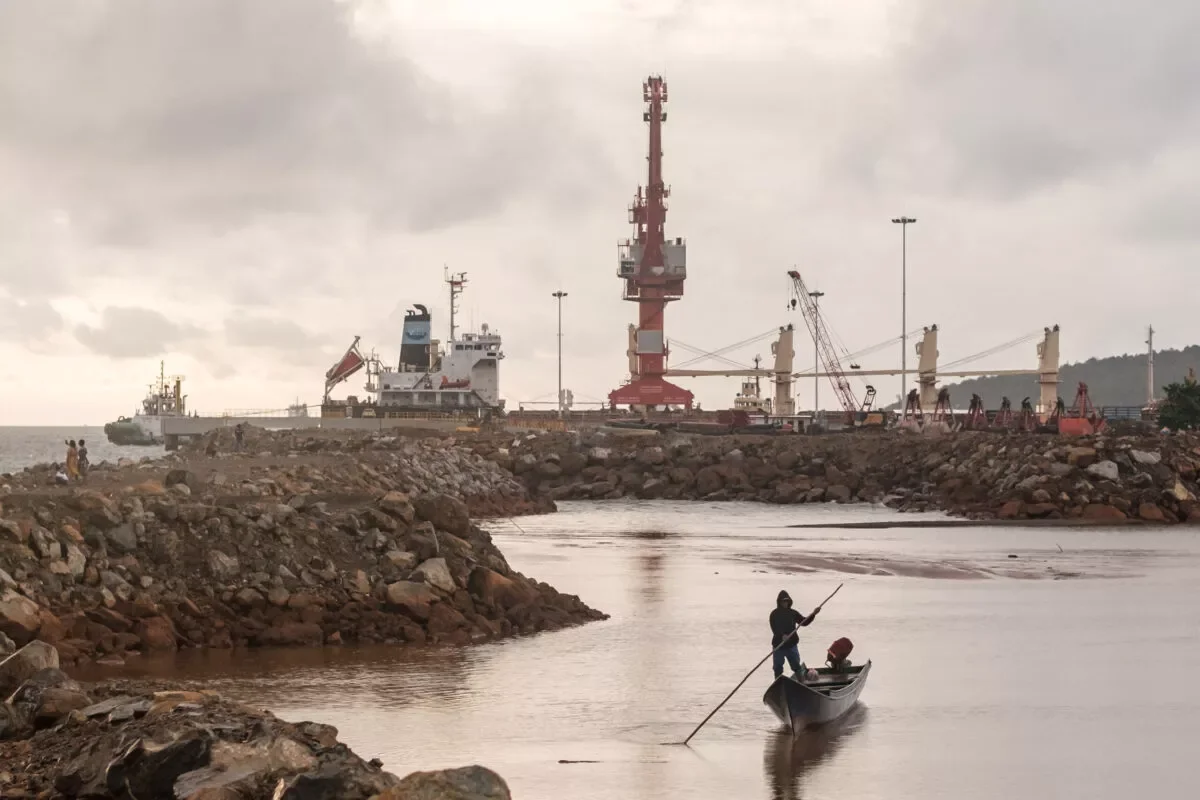
A fisherman passes by a transport port near a nickel mining company and processing smelter in Kawasi Village, on Obi Island, South Halmahera Regency, North Maluku Province, Indonesia, on August 29, 2024. Nickel mining development begins in 2010 by a subsidiary of PT. Harita Group. Massive forest destruction results in seawater pollution for small islands in eastern Indonesia. Indonesia becomes the largest nickel ore miner and contributes to the world's largest battery technology market | Photo by Muhammad Fauzy/NurPhoto
In this article for East Asia Forum, Althof Endawansa writes about how Indonesia’s strategy of processing its own nickel risks creating a green dependency trap, where the country builds processing capacity but remains reliant on Chinese technology and capital while global demand shifts to battery chemistries that need no nickel.
When Indonesian President Prabowo Subianto broke ground on 13 new natural resource processing projects worth US$7.2 billion on 29 April 2026, he called downstreaming — known locally as hilirisasi — the path to national revival. State investment vehicle Danantara is now coordinating 18 downstream projects worth around Rp 600 trillion (US$34 billion), with nickel as the centrepiece. By processing raw minerals at home, the logic goes, Indonesia can capture more value and escape the middle-income trap.
Indonesia crossed into upper-middle-income status in 2023, with a GNI per capita of US$4810 — still well below the US$13,935 high-income threshold. Meanwhile growth has hovered around 5 per cent for more than a decade, reaching 5.11 per cent in 2025. The World Bank’s 2024 World Development Report found that countries can break out of the middle-income trap only by combining investment with the absorption of foreign technology and home-grown innovation.
This is the case proponents make for downstreaming. If Indonesia can absorb foreign technology, transfer it to domestic firms and innovate at the next stage, downstreaming becomes a path out of stagnation. The risk is that the current architecture is built for volume, not capability.
This is where a green dependency trap appears. In a green dependency trap, a country builds processing capacity but stays in a junior role — tied to a single foreign partner for technology it cannot replicate, reliant on imported inputs it cannot make at home. Demand for the single mineral it processes may shrink as the green transition shifts to alternatives.