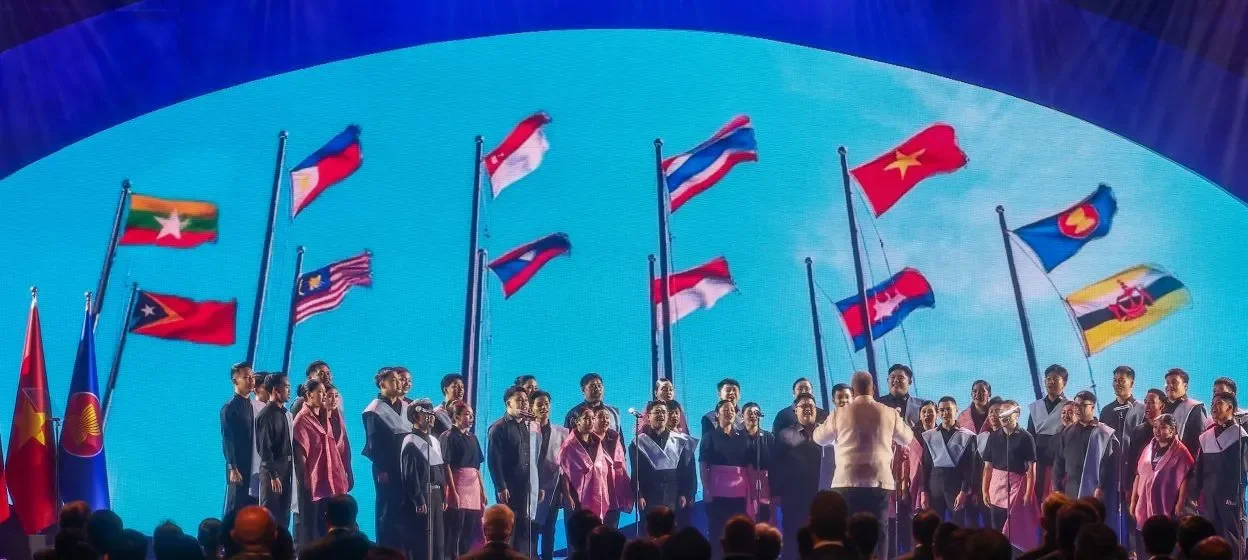
Performers sing the ASEAN anthem during the official opening ceremony of the 48th ASEAN Summit and Related Meetings in Cebu, Philippines, on May 8, 2026 | Photo by Daniel Ceng / Anadolu via AFP
In this article for Fulcrum, Joanne Lin, Kristina Fong and Melinda Martinus assert that as global crises become increasingly interconnected, ASEAN faces mounting pressure to strengthen energy security, maritime cooperation, and crisis coordination before the next disruption strikes.
The 48th ASEAN Summit in early May took place amid prolonged military action in the Middle East and growing risks to global trade. These pressures have exposed ASEAN’s vulnerability to external shocks, but they have also created a rare moment of policy convergence. At the summit, leaders renewed their focus on energy security, food resilience, trade facilitation, maritime cooperation, and crisis coordination. The ASEAN Leaders’ Statement on the Response to the Middle East Crisis provides a clear political anchor for these priorities.
Yet ASEAN has never been short of mechanisms or declarations. Over the years, it has introduced many initiatives in energy cooperation, maritime cooperation, trade facilitation, disaster response, and food security. In the not-so-distant past, the region attempted collective responses during Covid-19, from regional vaccine procurement to coordinating public-health measures and keeping goods and people moving across borders. Many of these efforts, however, eventually fell short due to limited institutional coordination and the tendency of member states to prioritise national responses during crises. The real test now is whether ASEAN can turn these statements into practical action and use this crisis to build a more credible collective agenda to respond to emergencies.
Deeper regional cooperation can be a means of strengthening resilience in the face of global risks. This has been a resounding theme in ASEAN, and has grown stronger in recent years. In the State of Southeast Asia Survey 2026 (SSEA2026), strengthening regional integration among the ASEAN Member States (AMS) was the overwhelming preferred response to rising protectionism and nationalism, cited by 42.2 per cent of respondents. ASEAN also stands as the perceived leader in championing global free trade as well as maintaining a rules-based order and upholding international law.