
Organizer: ISEAS – Yusof Ishak Institute
Type/Location: Virtual
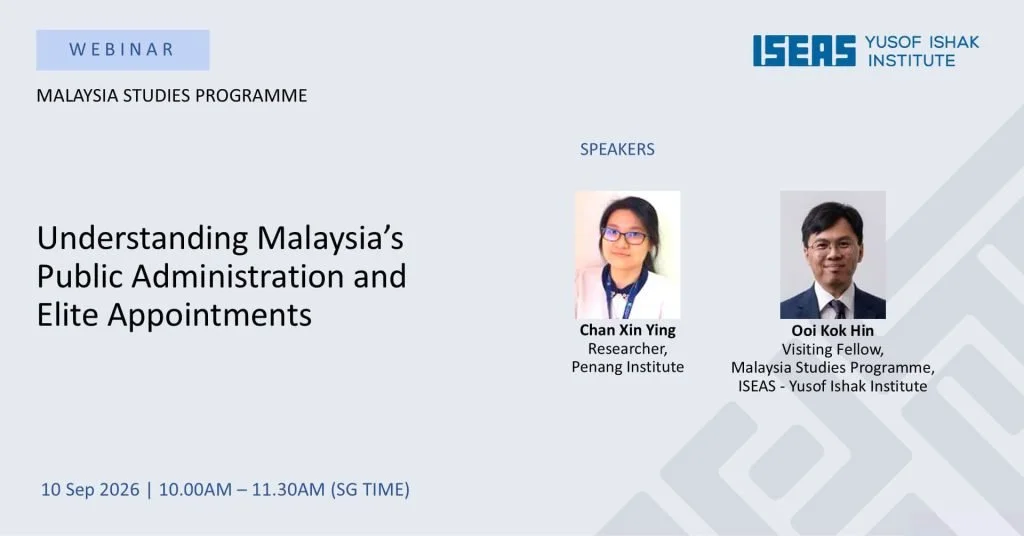
Description:
While political leadership can change frequently, certain governing institutions evolve more slowly, providing stability or continuity in periods of political transition. Beyond elections and the ascent of specific personalities, the bureaucracy can enable or encumber the implementation of reforms. Such is the case for Malaysia, a country undergoing deep-seated political change amid a strong tradition of government.
Malaysia’s federal public administration, which includes a civil service of around 1.3 million personnel as well as the police, armed forces, commissions and statutory bodies, operates in a complex architecture in which authority is distributed among political executives, central coordinating bodies, personnel agencies and constitutionally established service commissions. Understanding this institutional structure is essential to analysing how appointments are made and how political influence can be exercised.
These dynamics are explored by comparing Malaysia’s two Pakatan Harapan (PH)-led administrations: the Mahathir Mohamad government of 2018–2020 and Anwar Ibrahim’s Unity Government from 2022. Although both entered office with reform commitments, their approaches to bureaucratic change have differed substantially. The first PH administration was more willing to make convention-breaking appointments, but some proved disruptive or politically polarising. The second has adopted a more cautious approach, prioritising continuity, though this has frustrated supporters seeking faster reform. Comparing the timing, profiles and reception of these appointments provides a basis for assessing the opportunities and constraints facing bureaucratic and institutional reform in Malaysia’s increasingly fluid coalition era.
About the Speakers:
Chan Xin Ying is a Researcher at Penang Institute, and a PhD candidate in Political Science at the National University of Singapore.
Ooi Kok Hin is a Visiting Fellow with the Malaysian Studies Programme at the ISEAS-Yusof Ishak Institute. He is also the editor of Making Democracy Work: Institutional Reforms for Malaysia.
Registration:
To attend the event virtually, please register here.