
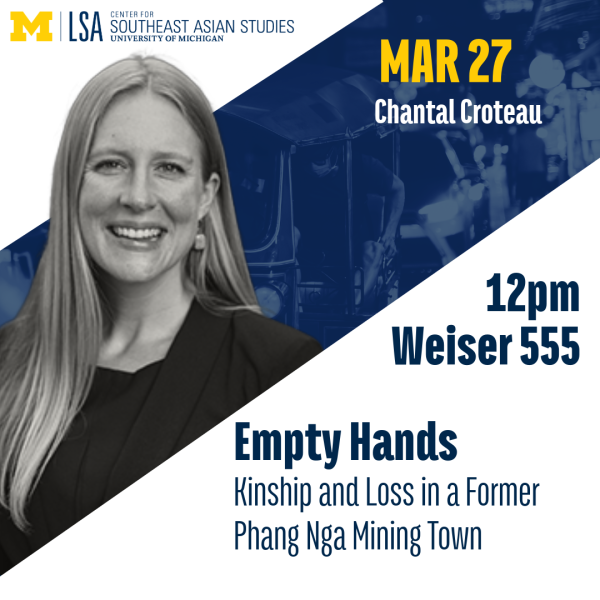
Organizer: Center for Southeast Asian Studies, The University of Michigan
Type/Location: Hybrid / Ann Arbor, MI
Description:
Industries of extraction have long flourished in the resource rich region of southern Thailand, the confluence of state interests and production coming to shape dynamics of intercommunal relations and to define and enforce categories of ethnicity and religion in the region. In this presentation, Chantal Croteau focuses on one such industry – the tin mining industry, which exploded along the southwestern coast of then Siam in the 19th century, generating significant social and economic changes and bringing individuals with different ethnoreligious identities, categories themselves remade and reformulated over time, together in arduous and risky labor, before the collapse of the industry in the late-1980s.
Drawing on ethnographic fieldwork and oral history conversations, she examines the relations of kinship, precarity, and loss generated through the volatile world of the boom-and-bust southern tin mining industry, a world made all the more unstable by earlier state practices that had cultivated debt and addiction within the mining community. Attending to narratives of economic precarity and migration and embodied practices of kinship such as the sharing of food and the caretaking of spiritually dangerous deceased persons, she analyzes how the building of intimacy and kinship can operate as a strategy of survival in unpredictable times. However, as the histories of my interlocutors reveal, the making of kinship requires continuous cultivation, as relations are fraught with fragility and risk.
About the Speaker:
Chantal Croteau is a PhD Candidate in Sociocultural Anthropology at the University of Michigan, Ann Arbor. Her long-term research investigates the intersections between extractive industries, ecological change, and intercommunal relations in southern Thailand. Previously, she was a Charlotte W. Newcombe Fellow in religion and ethics. Her creative ethnographic work has been featured in Anthropology & Humanism, Practicing Anthropology, and Anthropology News.
Registration:
To attend the event in person, please register here.
To attend the event virtually, please register here.