
Organizer: Center for Khmer Studies
Type/Location: Virtual
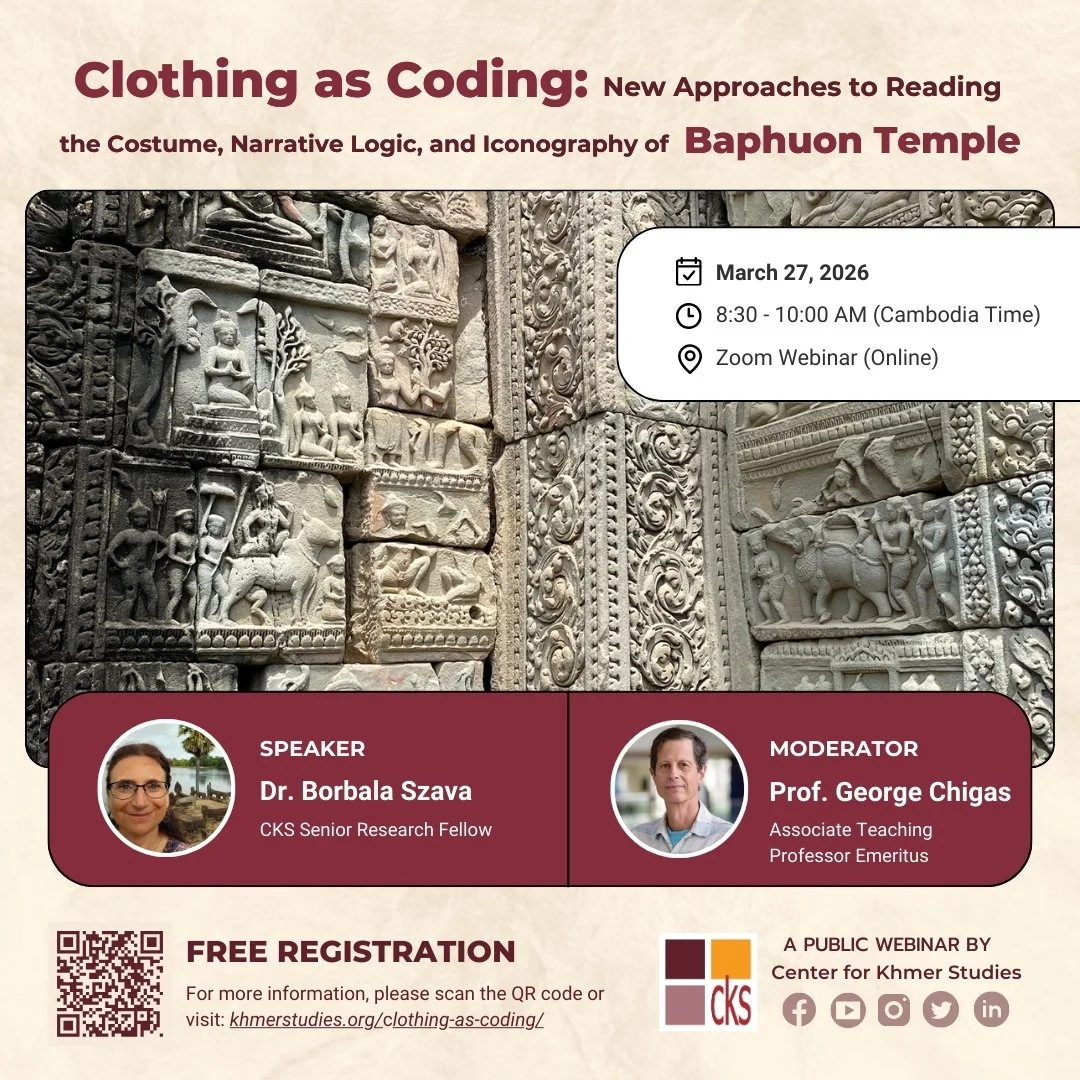
Description:
This lecture presents the preliminary results of a four-month fieldwork project examining costume and attire in the figural depictions of Baphuon temple (11th century, Angkor). Through systematic on-site documentation, archival research, and comparative analysis with contemporaneous monuments, the project constructs the first comprehensive costume database for Baphuon, currently comprising more than 800 entries. By analyzing garments, jewelry, and hairstyles within their narrative context, the study demonstrates that attire functions not merely as ornamentation but as a key iconographic marker. Specific costume types correlate with social rank, ritual function, and shifting narrative roles, allowing refined identification of mythological episodes. The findings suggest a more coherent narrative organization than previously recognized, including a patterned placement of Ramayana and Mahabharata scenes within the temple’s architectural framework. The lecture demonstrates that a costume-based methodological approach offers new insights into Baphuon’s iconographical program, spatial logic, and position within the development of 11th-century Angkorian art and culture.
About the Speaker:
Borbála Száva, PhD, is a historian and museum professional specializing in Angkorian iconography and costume studies. She received her PhD from the University of Pecs, Hungary, where her research focused on carved costume depictions at Banteay Srei temple. She has taught courses on Southeast Asian Art, religion, and history at Eotvos Lorand University, the University of Pecs, and Karoli Gaspar University. She previously worked as a curator of Southeast Asian museum collections in Budapest. Currently, she is an independent researcher conducting fieldwork in Cambodia on the iconography and costume typology of 11th-century Angkorian temples.
About the Moderator:
Prof. George Chigas is an Associate Teaching Professor Emeritus in Cambodian Studies at the University of Massachusetts Lowell, where he taught courses on Cambodian literature and cultural history. He earned his doctorate in Southeast Asian Languages and Cultures from the School of Oriental and African Studies (SOAS) at the University of London and his masters in Asian Studies from Cornell University. He is the author of Tum Teav, A Translation and Literary Analysis of a Cambodian Classic. He currently lives in Siem Reap, Cambodia.
Registration:
To attend the event virtually, please register here.