Why Southeast Asia Fights Over Food—but Shouldn’t, According to Experts
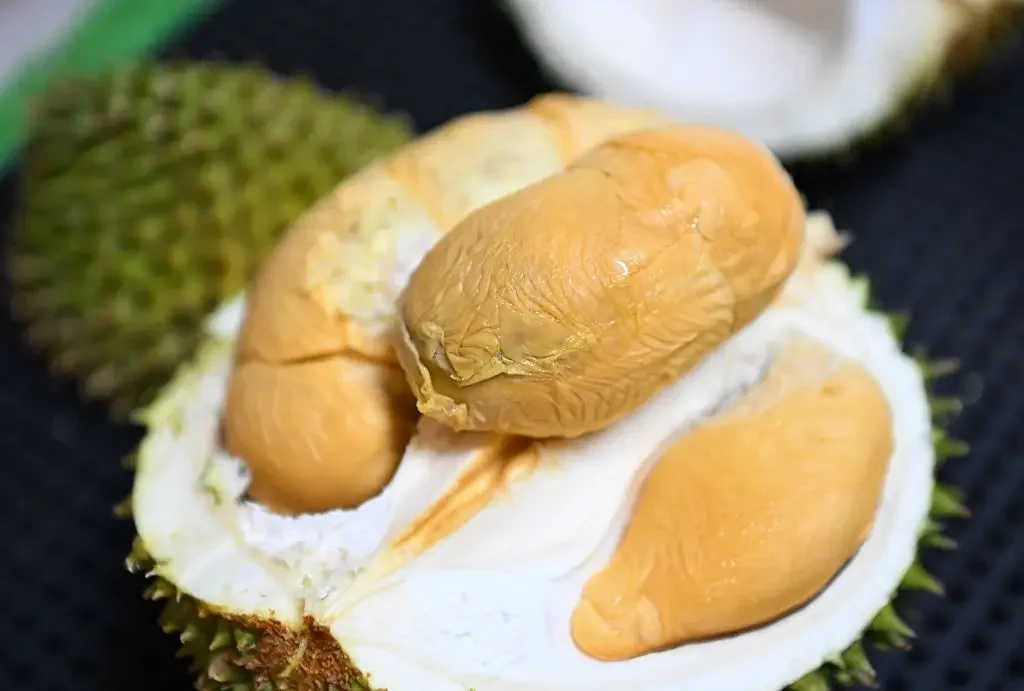
The yellow, edible flesh inside a durian fruit | Photo: Deng Hua—Xinhua News Agency/Getty Images
In an article for TIME Magazine, Miranda Jeyaretnam discusses the controversy among Southeast Asian countries over Malaysia wanting to claim durian as its national fruit.
A geopolitical battle is being waged over the so-called “king of tropical fruits,” a spiky, pungent, and polarizing fruit known as durian.
Durian gets a bad rap in the West, where it’s been described as having a “deep dank rot”—igniting debates about orientalist tropes in food writing—and made headlinesfor forcing an evacuation of a post office in Germany in 2020 and causing repeated gas leak false-alarms in the same country this year.
But in Southeast Asia, the iconic fruit is coveted—so much so that a group representing durian producers and manufacturers wants it to be formally recognized as Malaysia’s national fruit. The Sept. 8 proposal, submitted by Malaysia’s Durian Manufacturers Association (DMA), also asked the Agriculture and Food Security Ministry to make July 7 National Durian Day, which the association hopes will be celebrated through festivals, exhibitions, and farm visits.
“Durian is not just another fruit. It’s part of our national identity,” DMA president Eric Chan said, according to Malaysian news outlet The Star. “Every Malaysian, no matter their background, has a durian story—a memory, a tradition. It’s the one thing that unites us all.”
But making durian Malaysia’s national fruit also appears to have stoked divisions across the region.