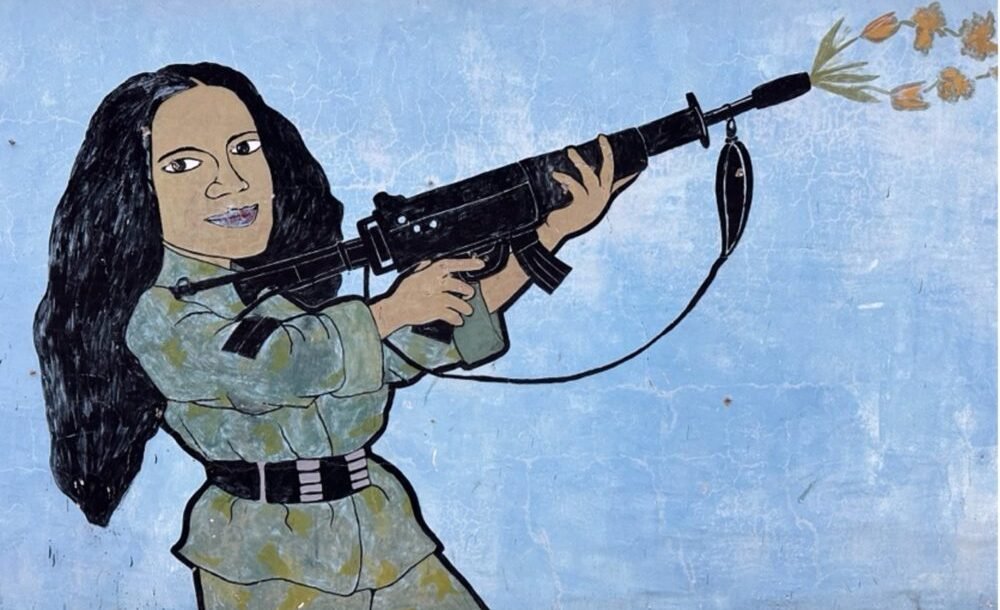
A public art mural of Bilesa, a famous female combatant, at Kampu Demokrasia FFTL, Dili | Photo by the authors
In an article for New Mandala, Muhammad Ammar Hidayahtulloh and Shelli Israelsen write about the women’s movement in East Timor. Amidst challenges in the movement such as patriarchal political scene, donor dependency, and deep intergenerational divides, the fight against sexual and gender-based violence is becoming a site of renewed unity in Timorese feminist advocacy.
Since the formal restoration of Timor-Leste’s independence on 20 May 2002, the women’s movement has evolved beyond the goal of national liberation to the struggle to secure an equal place for women in the new state. Gender equality principles have been formally recognised in Timor-Leste over the past 24 years, with constitutional guarantees for gender equality, parliamentary quotas for women, the Law on Domestic Violence, the National Action Plan on Gender-Based Violence, and the National Action Plan on Women and, Peace and Security counting among the key achievements of the women’s movement in the post-independence period. But while important institutional gains have been achieved, an increase in gender-based violence (GBV), as well as continuing barriers to education, employment and equal pay for women and girls, lay bare the reality that deeper transformations in gender relations remain limited.
Our ongoing research into the work of three major Timorese women’s organisations highlights how the women’s movement confronts intersecting factors that constrain space for effective advocacy. The challenges, we observe, start with patriarchal legacies of the independence struggle, particularly an official memorialisation of the resistance that marginalises women’s contributions and provides the ideological backdrop to a political scene dominated by male veterans of the resistance. Trends in international development policy, meanwhile, put pressure on women’s organisations to depoliticise their activities, positioning them as adjunct to state and donor agendas. More recently, the deep inter-generational divides within Timorese society have also been felt inside the women’s movement, as younger activists contest the position of established organisations. Yet at the same time, campaigns for justice for victims of sexual abuse have lately shown the potential for new alliances between veteran activists and the younger women who will carry forward their work forward.