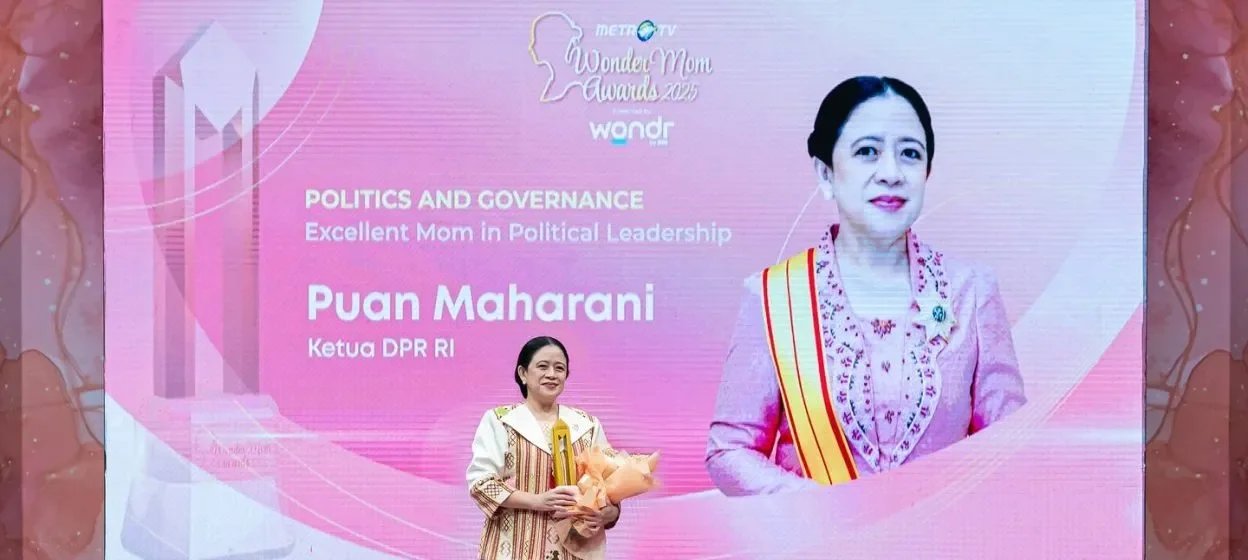
Puan Maharani, Speaker of Indonesia's House of Representatives – where only 22.1 per cent of MPs are women – receives an award at the Wonder Mom Awards 2025 for balancing motherhood and political leadership. Jakarta, December 22nd, 2025 | Photo from Puan Maharani / Facebook
In an article by Fulcrum, Kamilatul Farikhah asserts that women’s presence in Indonesia’s parliament still falls short of the 30 per cent quota and that they are underrepresented in parliamentary bodies handling strategic issues and in their leadership ranks.
For more than two decades, women activists have pushed to increase women’s representation in Indonesia’s parliament, but the results of their efforts remain uneven. In a country where women comprise nearly 50 per cent of the population, they currently hold only 22 per cent of seats in the House of Representatives (DPR), the highest figure since the 2004 legislative elections, when a 30 per cent quota for women came into effect. The requirement was later strengthened under Law No. 7/2017 on Elections, which requires party lists to include at least 30 per cent women candidates in each electoral district. However, the 2024 final candidate list found that only the Prosperous Justice Party (PKS), a national Islamist party, met the 30 per cent threshold across all DPR electoral districts, while many other parties still fell short of this target.
On paper, the quota and the gradual increase in the representation of women appear progressive. However, in practice, the increase has not made a significant change in the influence that women hold in parliament. Entrenched patriarchal norms continue to shape party and parliamentary culture, resulting in what some researchers call the “domestication” of women. This refers to the practice of assigning women to parliamentary commissions and committees (Alat Kelengkapan Dewan, AKD) handling issues that mirror women’s care-giving roles in the household — e.g., social welfare, education, health, and religion — rather than more strategic issues such as defence, law enforcement, intelligence, and energy. This division of labour locks women’s influence at the margins of the policy agenda, while the most consequential decisions continue to be taken in spaces dominated by men. In other words, the issue is not how many women enter parliament, but how much authority they actually have. Women’s struggle does not end once they have secured a seat in parliament; it begins at that point.
Women’s representation in leadership positions in most AKDs is also limited. In the current 2024–2029 DPR term, six of the 13 parliamentary commissions have no women in leadership roles. Even more egregious and ironic, Commission VIII, which should be a strategic space for women’s issues and child protection, does not have any women among its leaders. Overall, women hold only 18 of the 104 leadership seats across all 20 AKDs. This gap shows that although women now occupy more than one-fifth of DPR seats, they still hold fewer than one-fifth of leadership positions. Their access to real authority in parliament remains limited. This means key policies are often produced with little or no meaningful gender perspective.