Rightlessness After Reform? Agrarian Conflict and the Politics of Land in Indonesia
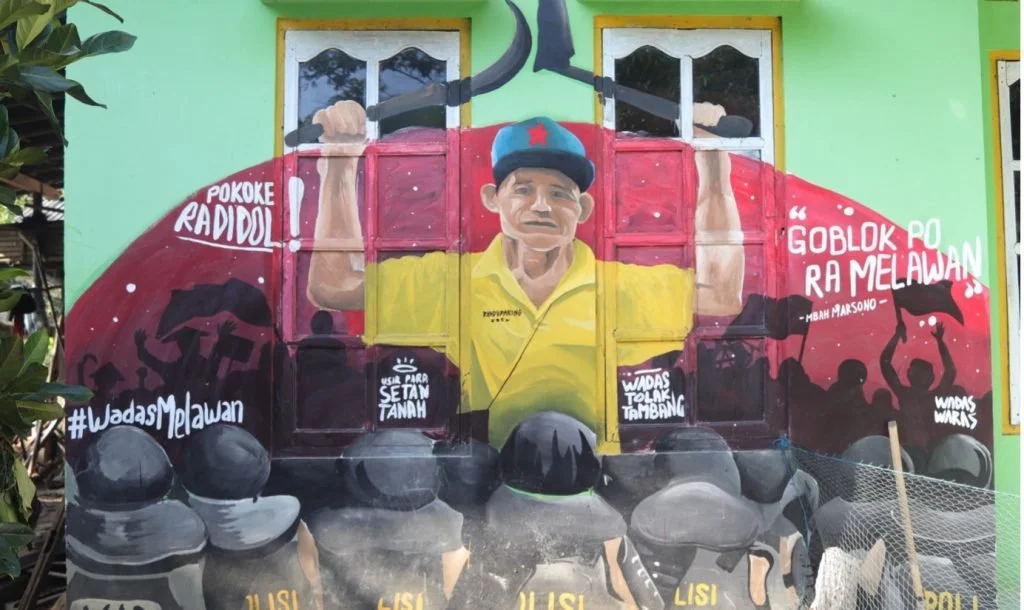
A mural in Wadas, a village affected by land conflict in central Java, depicting the repression rural resisters often face from security and military personnel | Photo: Annisa Sabrina Hartoto
In an article published by New Mandala, Annisa Sabrina Hartoto reviews Rightless Resistance: Postcolonial Citizenship, Palm Oil, and Land Grabs in Indonesia, edited by Ward Berenschot, Ahmad Dhiaulhaq, Afrizal, and Otto Hospes.
On 22 September 2026, the Indonesian parliament struck the gavel to enact the Law on Agrarian Reform (UU Reforma Agraria), marking an important milestone in Indonesia’s long struggle for agrarian justice. The new statutory framework includes several important and strategic provisions that expand the legal architecture of agrarian rights. These provisions guarantee the fulfilment, restoration, and recognition of people’s rights to land and agrarian resources, and establish mechanisms for resolving agrarian conflicts, restoring land rights, redistributing land, and providing de jure legal protection for communities defending their land.
Ratified just two days before National Peasants Day, the law appeared to offer a significant promise to farmers, Indigenous groups, fisherfolk, women, labourers, the urban poor, and other marginalised communities long affected by entrenched inequalities in land tenure and agrarian conflict. Yet its enactment also exposes a persistent paradox in Indonesian agrarian politics. The law indicates a potential expansion of agrarian rights at a time when conflicts over plantations, infrastructure, mining, and other development projects continue to reveal how difficult those rights are to exercise in practice. The CSO Konsorsium Pembaruan Agraria (Agrarian Renewal Consortium/KPA) reported that between 2021 and 2025, agrarian conflict cases increased by approximately 33 cases, or 13%, per year.
This tension between the formal expansion of rights and their limited practical effectiveness provides a useful entry point into a recently published book, Rightless Resistance: Postcolonial Citizenship, Palm Oil, and Land Grabs in Indonesia, by Ward Berenschot, Ahmad Dhiaulhaq, Afrizal, and Otto Hospes. The book asks why rural communities so often struggle to defend their interests against palm oil-related land grabbing despite mobilising in resistance. Its answer is that many rural Indonesians are not literally without rights, but are effectively “rightless” because legal protections are repeatedly weakened, circumvented, or rendered ineffective.
The central question raised by the book therefore becomes especially timely in light of the new law: what does it mean to expand agrarian rights in a political system where rights have so often failed to constrain more powerful actors? Rightless Resistance meticulously and convincingly shows how rightlessness shapes the forms of resistance available to rural communities, and consequently, their outcomes. But conflicts related to state-sponsored land dispossession, for example in places in Takalar and Wadas that I examine in my own research, also suggest that rightlessness can be reproduced through the process of dispossession itself with active state work, and that its form may vary across different political-economic regimes of land control.