The Backlash against NU’s Religious Diplomacy
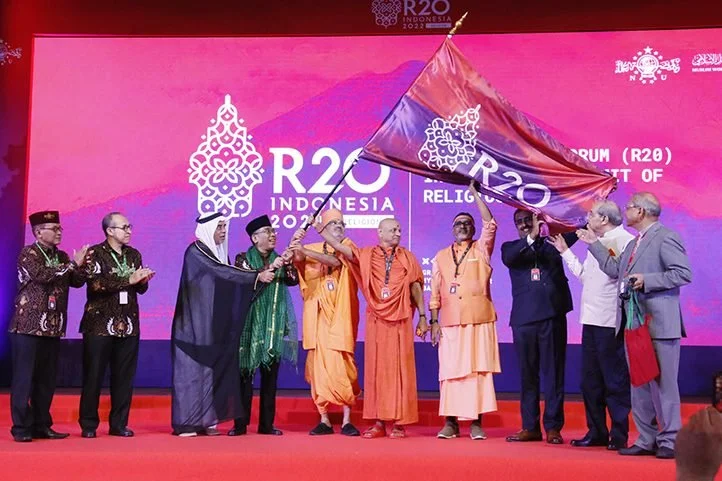
PBNU Chair Yahya Cholil Staquf (third from left) at the Handover of the R20, the G20-Affiliated Religious Dialogue Track, to Indian Representatives ahead of the G20 Summit in Bali, November 2022 | Photo: G20Religion.org
In this article published by New Mandala, Alexander R. Arifianto and Muhammad Garda Ramadhito assert that Nahdlatul Ulama’s quest to position itself as an international ambassador for “Humanitarian Islam” has backfired for its leaders, as controversies over their entanglements with neoconservative actors abroad feed into an ongoing leadership crisis ahead of the 2026 national congress.
On 24 August 2025, the former academic Peter Berkowitz delivered a lecture at the National Leadership Academy (AKN NU), the highest tier of cadre training by Nahdlatul Ulama (NU), Indonesia’s largest Islamic mass organisation. Berkowitz, now a senior fellow at the Hoover Institution, served as Director of Policy Planning at the State Department during Donald Trump’s first presidential administration and maintains extensive ties to pro-Israel and neoconservative foreign policy networks.
Those affiliations eventually became public controversy. In February 2025, Berkowitz published an open letter to Secretary of State Marco Rubio urging wide-ranging cooperation with NU, which was promoted on the website of the Center for Shared Civilizational Values (CSCV), the American organisation serving as NU’s international secretariat. Yet Berkowitz’s lecture drew little public notice until he appeared at a Universitas Indonesia forum on 23 August, where his record provoked a wave of online criticism and forced the university to apologise within a day. As NU’s own outlet acknowledged, it was the UI affair that brought Berkowitz to national attention, and with it, the fact that NU’s national executive board (Pengurus Besar Nahdlatul Ulama/PBNU) had hosted him the week before.
The clerical leadership sided with the critics. NU’s supreme spiritual leader (or Rais Aam) Miftachul Akhyar demanded the AKN NU academy be halted and that PBNU’s memorandum with CSCV be suspended. PBNU Chairman Yahya Cholil Staquf—widely known as Gus Yahya—apologised on 28 August, calling Berkowitz’s invitation an oversight. But it was not enough: in November 2025, Akhyar convened NU’s Syuriah oversight council to call formally for Gus Yahya’s removal as PBNU chair. A PBNU plenary dismissed him the following month, installing an acting chairman in his place. Gus Yahya contests the legal validity of both the Syuriah and PBNU’s actions, but nonetheless saw fit to apologise to PBNU colleagues over the Berkowitz affair and the organisation’s financial governance as the price of a second plenary that reversed his dismissal in late January 2026.
The crisis arrives at a particularly fraught moment. Widely regarded as the world’s largest Muslim organisation, NU is set to convene its 35th Muktamar (national congress) in East Java in August 2026, 100 years after the organisation’s founding in the same province. Gus Yahya has declared his intention to recontest the PBNU chairmanship.