Pete Hegseth’s Dangerous Call to Arms in Asia
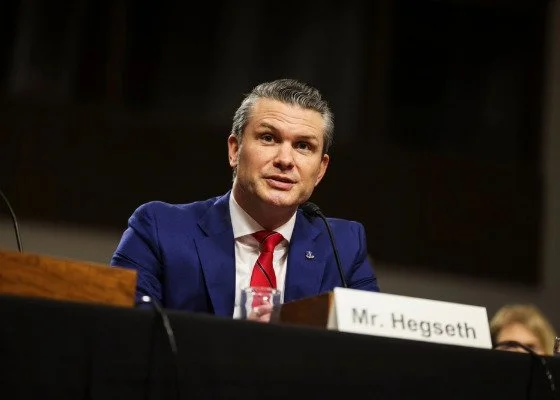
Pete Hegseth, Secretary of Defense nominee, testifies before the Senate Armed Services Committee on January 14, 2025 in Washington, D.C.
In an article for Asialink, Thitinan Pongsudhirak asserts that the Trump administration calling for Asians to spend more on defense risks igniting a regional arms race amid increasing tensions between China and the United States.
At the recent Shangri-La Dialogue in Singapore, US Defense Secretary Pete Hegseth pressed America’s Asian allies to spend 3.5% of their GDP on defence, fuelling anxiety across the region and beyond. His brow-beating call to arms may well bring about a regional defence build-up on a scale unseen since the Cold War’s end.
Such an outcome will actually do little to bolster regional security or address US defence concerns. For one thing, China may very well respond in kind, thus delivering limited to no benefits from the increased spending.
The Association of Southeast Asian Nations, the 11-member bloc south of China and east of India, has been a mostly peaceful region since the brief 1979 Sino-Vietnamese War. Notwithstanding ASEAN’s shortcomings and internal divisions—the group comprises democracies like Indonesia, Malaysia, the Philippines, and Singapore, autocracies like Cambodia, Laos, and Vietnam, and military juntas like Myanmar—it has long been the only entity with enough credibility to oversee regional security.
To steer large powers like China, the United States, India, and Japan away from confrontation and conflict in the Indo-Pacific, ASEAN has acted as buffer, bridge, and broker, prioritising dialogue and diplomacy over military muscle. As Winston Churchill once put it, “meeting jaw to jaw is better than war.”
But in Singapore, Hegseth castigated the region’s leaders for this approach, saying: “We don’t need more conferences. We need more combat power … less Shangri-La, more ships, more subs.”