Myanmar’s Overvalued Exchange Rates Are a Recipe for Economic Deterioration
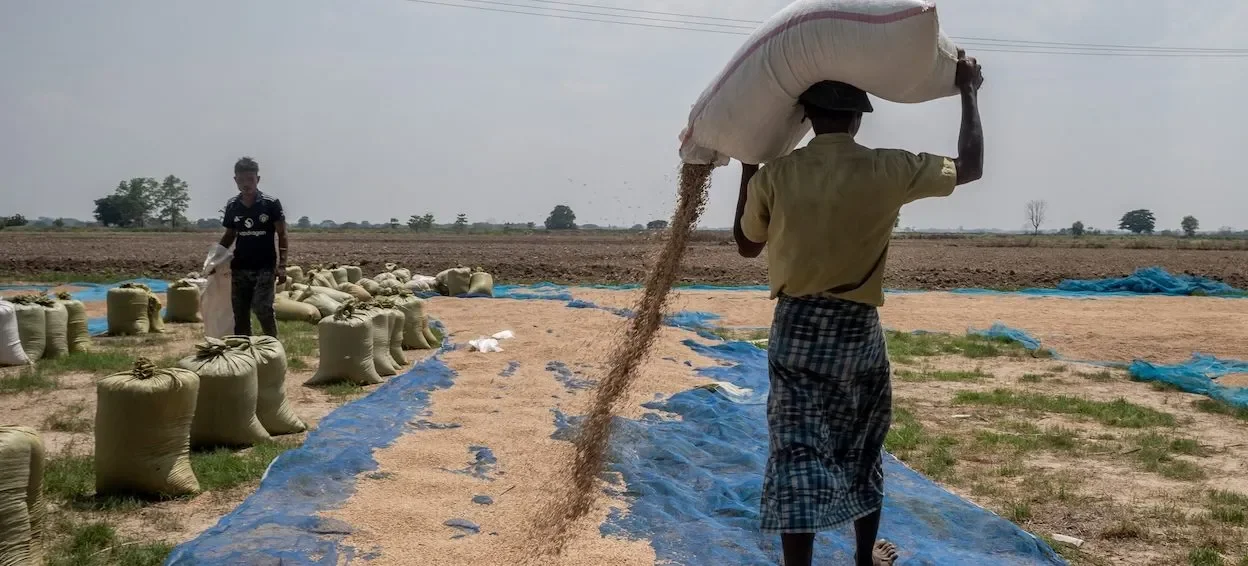
A worker pouring out rice grains to dry in the sun on the outskirts of Zalun township in Myanmar's Irrawaddy delta region | Photo by Sai Aung MAIN / AFP
In an article for Fulcrum, Jared Bissinger asserts that the people of Myanmar will continue to suffer under the current government’s overvalued exchange rates and vague economic direction.
The latest iteration of Myanmar’s military government took power in April 2026 and shortly thereafter, laid out its 100-day plan. The plan makes little mention of an economic agenda, besides vague references to improving agriculture, increasing rural lending and some infrastructure investments. However, the regime seems poised to retain economic policies adopted by the former State Administration Council (SAC), including the system of multiple overvalued exchange rates. Overvaluation has numerous negative effects. It reduces export earnings, shrinks export volumes, makes imports scarce, incentivises informality and affects import prices — making some cheaper and others more expensive. If Myanmar’s military government continues this approach or doubles down in response to the global energy crisis, it will reduce the prospects for an economic rebound and exacerbate the country’s long-run economic challenges, while undermining the regime’s own economic agenda.
Since 2022, the Central Bank of Myanmar has tightly controlled exchange rates. In April 2022, it set the official rate to 1,850 Myanmar kyat (MMK) per US dollar (USD) and in August 2022 adjusted it to 2,100 MMK/USD — where it has remained since. It created other rates, including an online platform rate, which stood at 3,658 MMK/USD at end-May 2026. By contrast, Myanmar’s unofficial rate was 4,245 MMK/USD. This makes the two key official rates overvalued by 16 and 102 per cent, respectively. To force individuals and businesses to use official rates, the regime employs a series of trade licences and other controls.
Overvaluation directly harms Myanmar’s exporters. When exporters bring US dollars (or other foreign currencies) back to Myanmar, they are forced to change them to Myanmar kyat at either the official or platform rate. Most exporters must convert 15 per cent at the official rate and 85 per cent at the platform rate, so they receive 3,423 MMK for every USD they bring back. Some businesses, such as garment manufacturers, can change all their incoming payments at the platform rate, so they receive a bit more: 3,658 MMK/USD. However, both are less than the 4,245 MMK/USD they would receive if they changed money at the unofficial rate. The result: exporters get less local currency from their exports.