Military Elections Will Not Resolve Myanmar’s Deeper Problems
Picture: SAI AUNG MAIN / Contributor / Getty Images
In an article for Asia Society Policy Institute, Dr. Hunter Marston asserts that the recent elections in Myanmar are designed to favor the military.
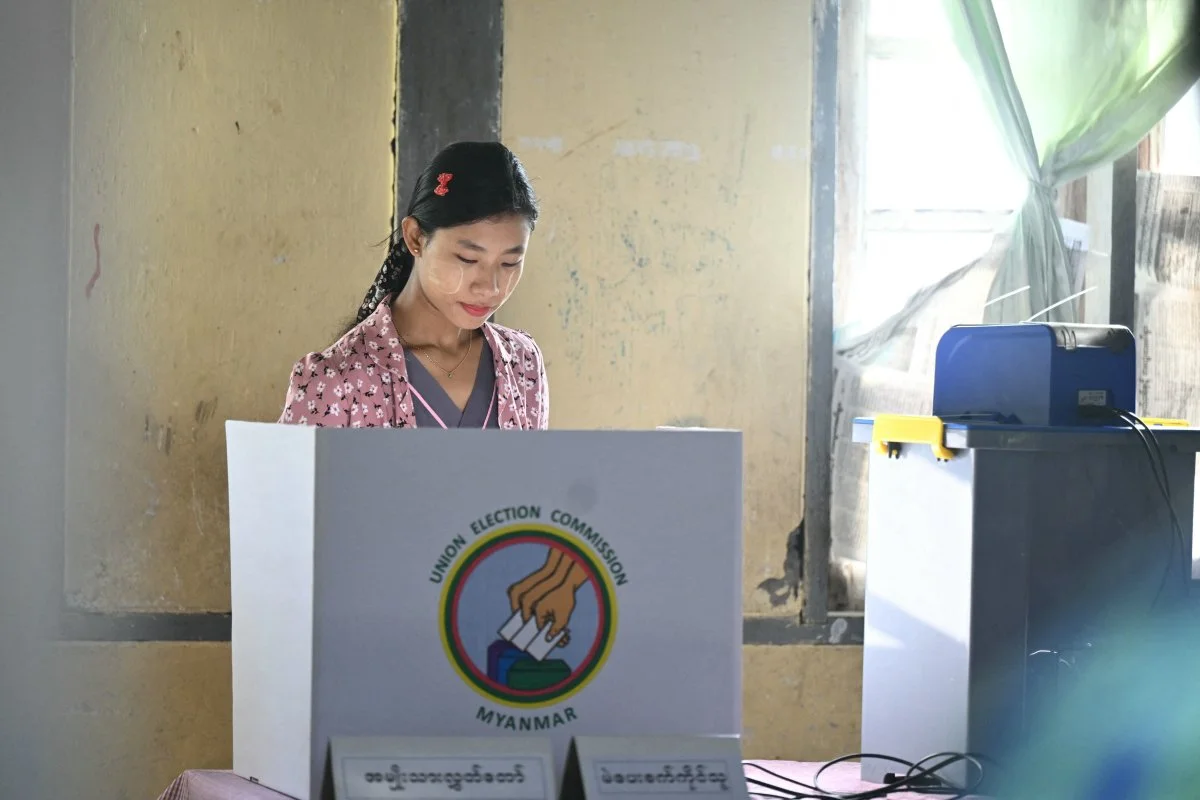
On January 11, Myanmar’s military conducted the second in a three-phase process of carefully stage-managed elections, with a final phase of voting to be held on January 25. With major opposition parties like the National League for Democracy (NLD) barred from running, the military’s proxy party, the Union Solidarity & Development Party (USDP), is all but guaranteed to win. Myanmar citizens have described voting in a climate of fear and expressed deep distrust of the regime’s fraudulent election exercise. The process is engineered to ensure that the military retains political power.
Roots of Conflict: Myanmar’s Contested Political Landscape
Since taking power in an unconstitutional coup in February 2021, Myanmar’s military has continually renewed a state of emergency and pledged to return the country to democracy by holding multiparty elections. The regime has sidelined any meaningful opposition in its effort to retain political power while nevertheless presenting a palatable face to the international community to restimulate foreign investment and allay fears of regime change. The fundamental paradox is that as long as the military holds power and ignores the interests of its people, it will be at war with a number of resistance groups that oppose military rule.
The military hopes the election will reset the clock to 2010, when it previously held elections that paved the way for the USDP to assume power based on the military-drafted 2008 Constitution. However, the USDP has never been as popular as the military anticipated, and people continue to support the NLD, even when it is sidelined. With Aung San Suu Kyi under house arrest during the 2010 national elections, the NLD opted to boycott the polls. In 2012, it won 43 of 44 open seats, an early indicator of the party’s enduring popularity. When Aung San Suu Kyi entered office that year, the international community applauded the USDP’s political reforms under President Thein Sein, a retired general who surprised analysts with his liberalization policies.