Establishment Forces Prevail as Thailand’s Progressives Fall Short
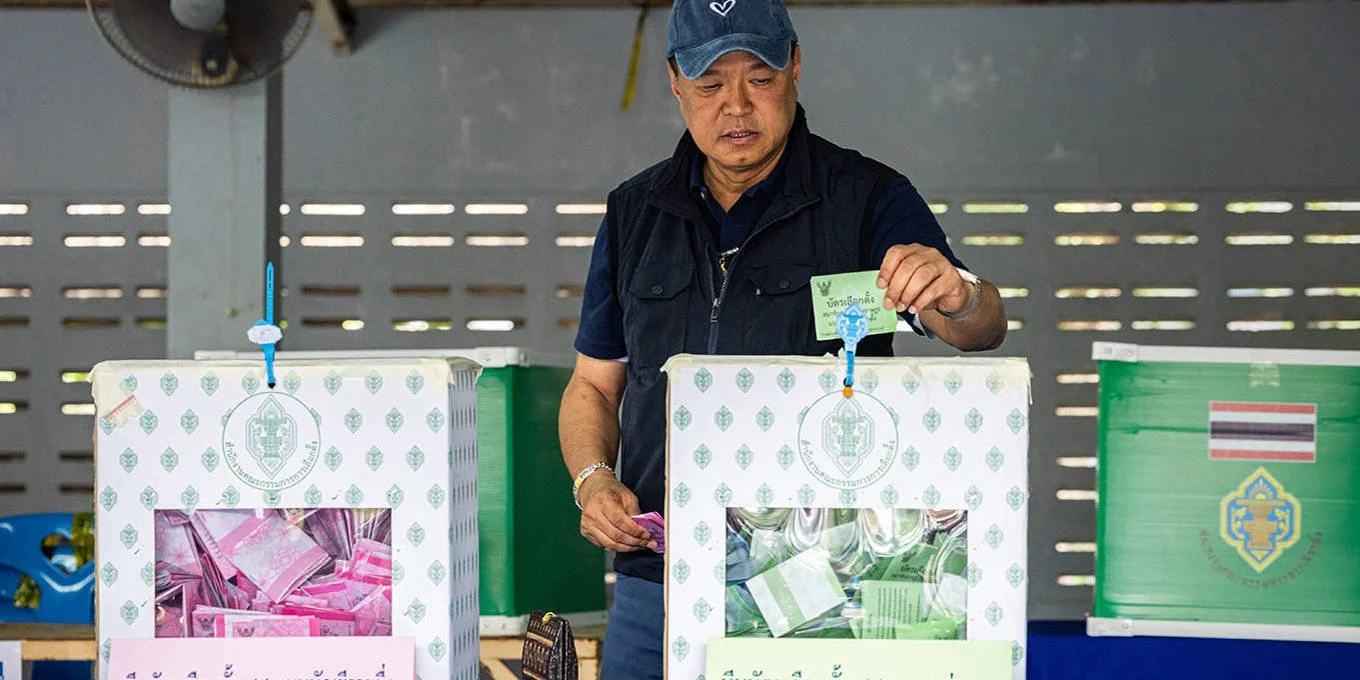
Thailand's Prime Minister and Bhumjaithai Party leader Anutin Charnvirakul casts his ballot in Thailand's general election at a polling station in Buriram province on February 8, 2026 | Photo by Anthony Wallace/AFP via Getty Images
In an article for the Asia Society Policy Institute, Bryanna Entwistle writes about various factors that led to the People’s Party’s defeat in Thailand’s recent general election.
For a moment, it seemed as if progressive forces in Thailand might prevail over the military-royalist-backed establishment. Ahead of the election on February 8 — which was called by Prime Minister Anutin Charnvirikul before a March deadline to avoid a no-confidence vote — the progressive People’s Party (PP) led Anutin’s conservative Bhumjaithai (BJT) party in the polls. But in a surprising resurgence, BJT pulled ahead to win 193 seats of the 500-member House of Representatives, more than doubling their representation in parliament and securing Anutin’s position as the prime minister.
The People’s Party’s shocking defeat harkens back to the disappointment of 2023 when its predecessor, the Move Forward Party, won a majority of votes but was blocked from forming a government by Thailand’s then-military-appointed Senate. This time seemed to feel different. The temporary constitutional provision that gave the Senate veto power expired in 2024; and ahead of the election, onlookers speculated that the popularity of PP and the removal of this obstacle might usher in a new, progressive era in Thai politics.
Instead, Bhumjaithai’s victory marks the first time in the 21st century that a conservative party has won a majority of seats in a Thai general election. Meanwhile, with 94% of the votes counted at the time of writing, the People’s Party’s representation has fallen from 151 to 118. The results signal popular support for Thailand’s military and royalist establishment after a year defined by sluggish economic growth and the eruption of a conflict with Cambodia that displaced nearly half a million people on either side of the border. Amidst uncertainty at home and a changing order abroad, Thailand’s voters opted for the conservative status quo.