Duterte’s ICC Case Questions Whether Justice Can Be Done
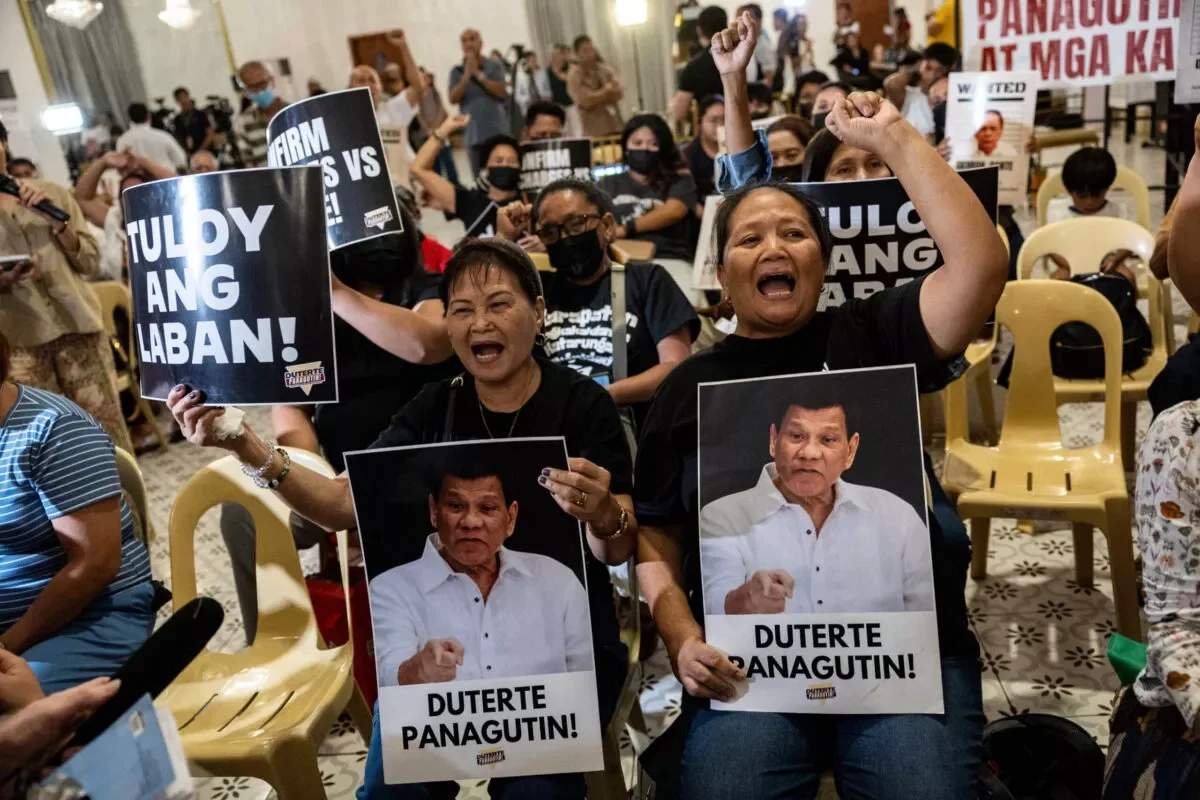
Relatives of drug war victims holding placards that say "the fight continues" and "make Duterte accountable" in Filipino, react after watching a livestream of the International Criminal Court's rejection of former Philippine President Rodrigo Duterte’s challenge to the court’s jurisdiction over his alleged crimes against humanity charges, in Quezon City, Philippines, April 22, 2026 | REUTERS/Eloisa Lopez
In this article for East Asia Forum, Lowell Bautista writes about how Rodrigo Duterte’s case before the International Criminal Court exposes broader tensions between sovereignty and accountability and the outcome will shape Duterte’s legacy, as well as broader perceptions of the Court’s legitimacy in Southeast Asia, where support for international criminal processes remains contested.
When former Philippine president Rodrigo Duterte appeared before the International Criminal Court (ICC) in February 2026, the question was not only whether he would face trial. It was whether international law can meaningfully confront authority that retains popular legitimacy while dispensing with legal restraint.
The case has passed through the confirmation of charges hearing, where judges assessed there to be ‘substantial grounds to believe’ that Duterte committed the alleged crimes. In late April 2026, the ICC Appeals Chamber rejected a defence challenge to the ICC’s jurisdiction, affirming that the case will proceed. The Pre-Trial Chamber also confirmed the charges against Duterte — the final step before proceeding to trial.
Prior to this point, the Court had conducted preliminary examinations and investigations, issued an arrest warrant and undertaken initial appearance proceedings. Victims have also submitted views through legal representatives. The decision to prosecute Duterte reflects multiple layers of legal scrutiny, and the stakes extend beyond one case.
ICC prosecutors argue that Duterte’s anti-drug campaign between 2011–19 amounted to a ‘widespread and systematic attack directed against the civilian population’ and that he played a pivotal role in a pattern of killings numbering in the thousands. The defence has countered that these claims rest on a misreading of political rhetoric and that Duterte’s public statements were ‘hyperbole’ rather than evidence of a coordinated criminal policy.