
Organizer: ISEAS – Yusof Ishak Institute
Type/Location: Hybrid / Singapore
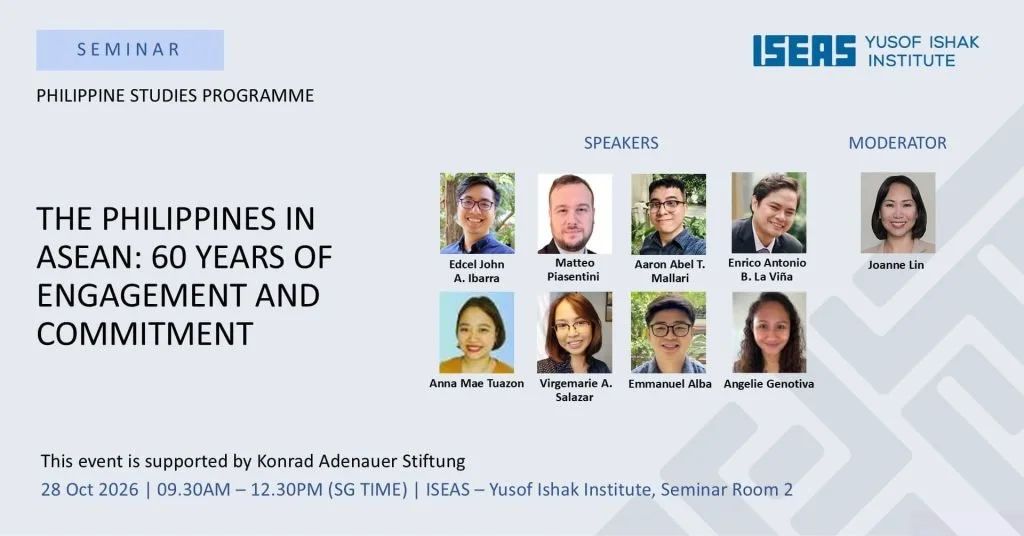
Description:
For six decades, the Philippines has been an active participant in ASEAN community building, from its founding in 1967 to the development of an increasingly integrated regional community. This webinar examines the reciprocal relationship between Philippine foreign policy interests and ASEAN cooperation across the political-security, economic, and socio-cultural pillars. It explores how Philippine initiatives have contributed to regional institutions, norms, and agendas, while examining how ASEAN cooperation has advanced Philippine interests in areas such as maritime governance, trade and investment, connectivity, labour, and migrant protection, public health, and people-to-people relations. The webinar also considers the factors that have enabled or constrained Philippine contributions to ASEAN community building, including tensions between regional commitments and domestic priorities. Finally, it examines the uneven progress and challenges in implementing successive ASEAN community blueprints and their implications for Philippine interests. Together, the panel reflects on 60 years of Philippine engagement with ASEAN and asks what the experience reveals about the opportunities and limitations of regional cooperation in advancing Philippine security, development, and welfare.
About the Speakers:
Edcel John A. Ibarra is Assistant Professor at the Department of Political Science, University of the Philippines Diliman, and the managing editor of the Philippine Political Science Journal. He is also Young Leader and US-Philippines Alliance Next-Generation Leader at the Pacific Forum in Honolulu, Hawaii, and the recipient of the 2024 Aileen San Pablo Baviera Prize conferred by the Graduate Research and Development Network on Asian Security based at the Australian National University in Canberra.
Matteo Piasentini is Senior Lecturer at the Department of Political Science, University of the Philippines Diliman, and PhD candidate at the same institution. He is also a research fellow at Pacific Forum and an external analyst for FACTS Asia. His academic work primarily explores the foreign and defense policies of the Philippines and minilateral security cooperation in the Indo-Pacific. In parallel, he serves as a coordinator and analyst for the China and Indo-Pacific program at Geopolitica, a leading Italian think tank, where he contributes with policy briefs and analytical papers focusing on Philippine foreign policy and Italy’s strategic engagement with the Indo-Pacific.
Aaron Abel T. Mallari is Assistant Professor and PhD student in the Department of Political Science, University of the Philippines Diliman where he also teaches courses in comparative politics and international relations. His research covers three broad topics: (1) emotions and politics; (2) crime and punishment; and (3) Philippine labor migration. These areas come together in his doctoral project about the case of overseas Filipinos in death row abroad analysed through the lens of the emotional turn in politics and international relations.
Dr. Enrico Antonio B. La Viña is Assistant Professor of Political Science at the University of the Philippines Diliman. He holds a PhD in Political Science from the University of California, Davis, specializing in Comparative Politics and International Relations. His research interests include democratization, political violence, the political economy of development, and international political economy. His work examines how economic conditions, political institutions, bureaucratic incentives, and electoral dynamics shape democratic politics and political violence, with particular attention to the Philippines.
Anna Mae Tuazon is an independent ASEAN engagement advisor and M&E specialist with over 20 years of international development experience. A former Senior Officer at the ASEAN Secretariat’s Integration Monitoring Directorate, she contributed to developing and operationalizing the M&E frameworks for the two prior ASEAN Economic Community (AEC) Blueprints. She currently works on various regional initiatives, including with the Ottawa-based international development consulting firm Cowater International, specializing in regional economic integration, SME development, women’s economic empowerment, and evaluations.
Dr. Virgemarie A. Salazar is Assistant Professor at the Department of Political Science, University of the Philippines Diliman, where she teaches international relations and qualitative research courses. She obtained her doctoral degree in Asia-Pacific Studies from the National Chengchi University in Taipei, Taiwan. Before pursuing her PhD, she worked as a Senior Foreign Affairs Research Specialist at the Center for International Relations and Strategic Studies of the Foreign Service Institute, the research and training arm of the Department of Foreign Affairs. Her research interests include regionalism in Southeast Asia, non-traditional security issues such as disasters and climate change, and Philippine foreign policy.
Emmanuel Alba is a Teaching Associate at the Department of Political Science, University of the Philippines Diliman. He holds a degree in Social Sciences, with specializations in Anthropology and Political Science, from the University of the Philippines Baguio. He previously served as a Senior Researcher and Chief Data Analyst at the House of Representatives, where he worked on legislative policies and social development programs. In 2023, he received the Natatanging Abukenyo Award (Notable Citizen of Abucay) and the Gawad Huwarang Kabataan Award from the Local Government of Abucay, Bataan, in recognition of his leadership and academic excellence. His research interests include Indigenous politics in international relations, and the intersection of politics and culture.
Angelie Genotiva is a PhD student in political science at the Department of Political Science, University of the Philippines Diliman. She also serves as an assistant professor (on leave) at the Visayas State University (VSU) Main Campus in Baybay City, Leyte, where she teaches and conducts research and extension work. As a qualitative researcher, her fieldwork focuses deeply on the complexities of local political dynamics, environmental governance, postdisaster recovery, and indigenous migrant communities.
Registration:
To attend the event in person, please register here.
To attend the event virtually, please register here.