
Organizer: ISEAS – Yusof Ishak Institute
Type/Location: Hybrid / Singapore
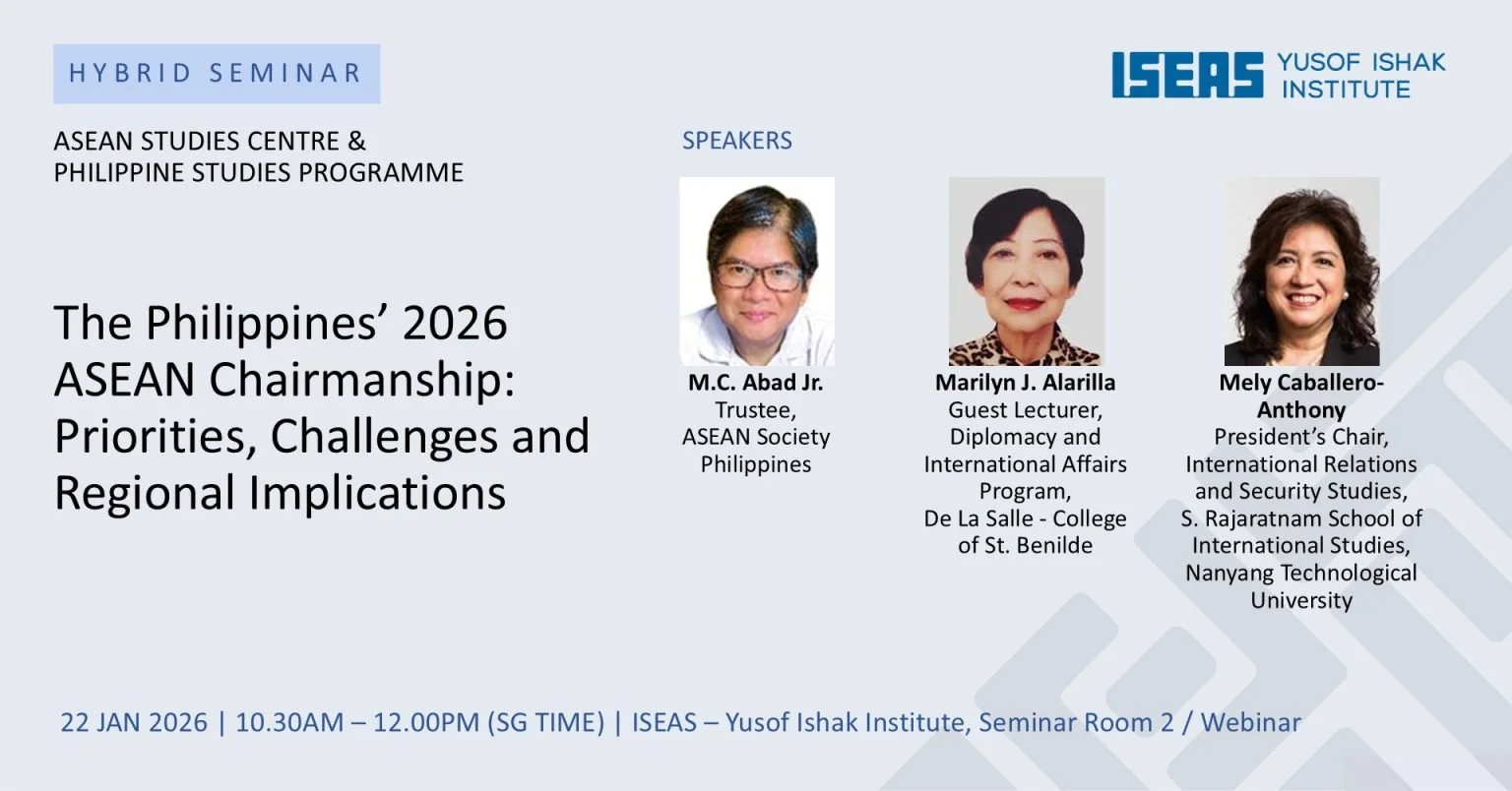
Description:
As the Philippines assumes the ASEAN Chairmanship in 2026, the region will be navigating one of its most challenging strategic environments in recent years. Manila has already signalled that its term will prioritise revitalising ASEAN’s role in maintaining regional stability, advancing ASEAN Community Vision 2045 and reinvigorating momentum on the long-stalled Code of Conduct (COC) negotiations in the South China Sea. The combination of rising major power tensions, accelerating defence postures around the maritime domain, and intensifying geopolitical competition makes the Philippines’ Chairmanship a pivotal moment to strengthen ASEAN’s relevance and agency.
Domestically, the Philippines brings a unique mix of opportunities and vulnerabilities to the role. Its more assertive stance in the South China Sea, commitment to international law and efforts to diversify strategic partnerships give Manila a distinct voice within ASEAN. At the same time, intra-ASEAN divisions, the continuing crisis in Myanmar and emerging challenges such as digital governance, economic resilience, supply chain security and disaster management will test the bloc’s ability to advance a coherent agenda. How the Philippines navigates both hard security flashpoints and functional cooperation will shape expectations of ASEAN’s ability to deliver results in 2026.
This seminar brings together leading experts and practitioners to examine the priorities, constraints and opportunities of the Philippines’ 2026 Chairmanship. Speakers will assess Manila’s likely approaches to key regional issues, including South China Sea dynamics, the Myanmar crisis and ASEAN’s broader institutional agenda. They will also consider the practical deliverables that could emerge under the Philippines’ Chairmanship, from strengthening ASEAN-led mechanisms and advancing external partnerships to driving progress on economic integration, disaster relief coordination and people-centred initiatives. The session aims to provide policymakers, analysts, and the public with a grounded and forward-looking understanding of how the Philippines may shape ASEAN’s trajectory in the coming year. The seminar will be held in hybrid mode at ISEAS.
Click here for program details.
About the Speakers:
M.C. Abad Jr. is a Trustee of ASEAN Society Philippines. He served as the first Director of the ASEAN Regional Forum at the ASEAN Headquarters in Jakarta from 1997-2007, Chief Presidential Staff Officer in the Office of Philippine President Corazon Aquino from 1987 to 1992, Chairman of the Institute for Strategic and Development Studies in the Philippines from 2009 to 2019, and Head of Government Relations at the Asian Development Bank from 2008 to 2024. He obtained his Masters of International Relations from the University of Sydney, Masters of Public Administration from the University of the Philippines and participated in the Executive Program on National and International Security from Harvard Kennedy School.
Retired Ambassador Marilyn J. Alarilla was the Philippine Ambassador to Turkey (2011-2013) and Laos (2009 to 2011). She was posted at the Philippine Embassies in Jakarta, Paris, Tokyo and Bern. She is currently a Guest Lecturer at the Diplomacy and International Affairs Program at the De La Salle – College of St. Benilde; Adjunct Professor at the Silliman University; and Senior Fellow at the Philippine Public Safety College. Ambassador Alarilla completed her Master’s in Diplomatic Studies at the Centre for Diplomatic and Strategic Studies (Paris), Master’s in Public Administration at the University of the Philippines (UP) and Master’s in Business Management at the Asian Institute of Management (AIM).
Professor Mely Caballero-Anthony holds the President’s Chair in International Relations and Security Studies at the S. Rajaratnam School of International Studies (RSIS), Nanyang Technological University, where she also serves as Head of the Centre for Non-Traditional Security Studies and Associate Dean for External Engagement. Her work focuses on Asia-Pacific regionalism, multilateralism, non-traditional and human security, nuclear security, peacebuilding, and global governance. She has led major international research projects and held leadership roles in key global networks, including the World Economic Forum’s Global Council on Nature and Security and the International Climate Security Expert Network. She previously served on the UN Secretary-General’s Advisory Board on Disarmament Matters (2013–2017), chairing it in 2016. She has published widely on Asia-Pacific security, including her recent article “Climate Security in Southeast Asia: Navigating Concepts, Approaches and Practices” (Third World Quarterly, 2024).
Registration:
To attend the event in person, please register here.
To attend the event virtually, please register here.