
Organizer: Center for Khmer Studies (CKS)
Type/Location: Virtual
Description:
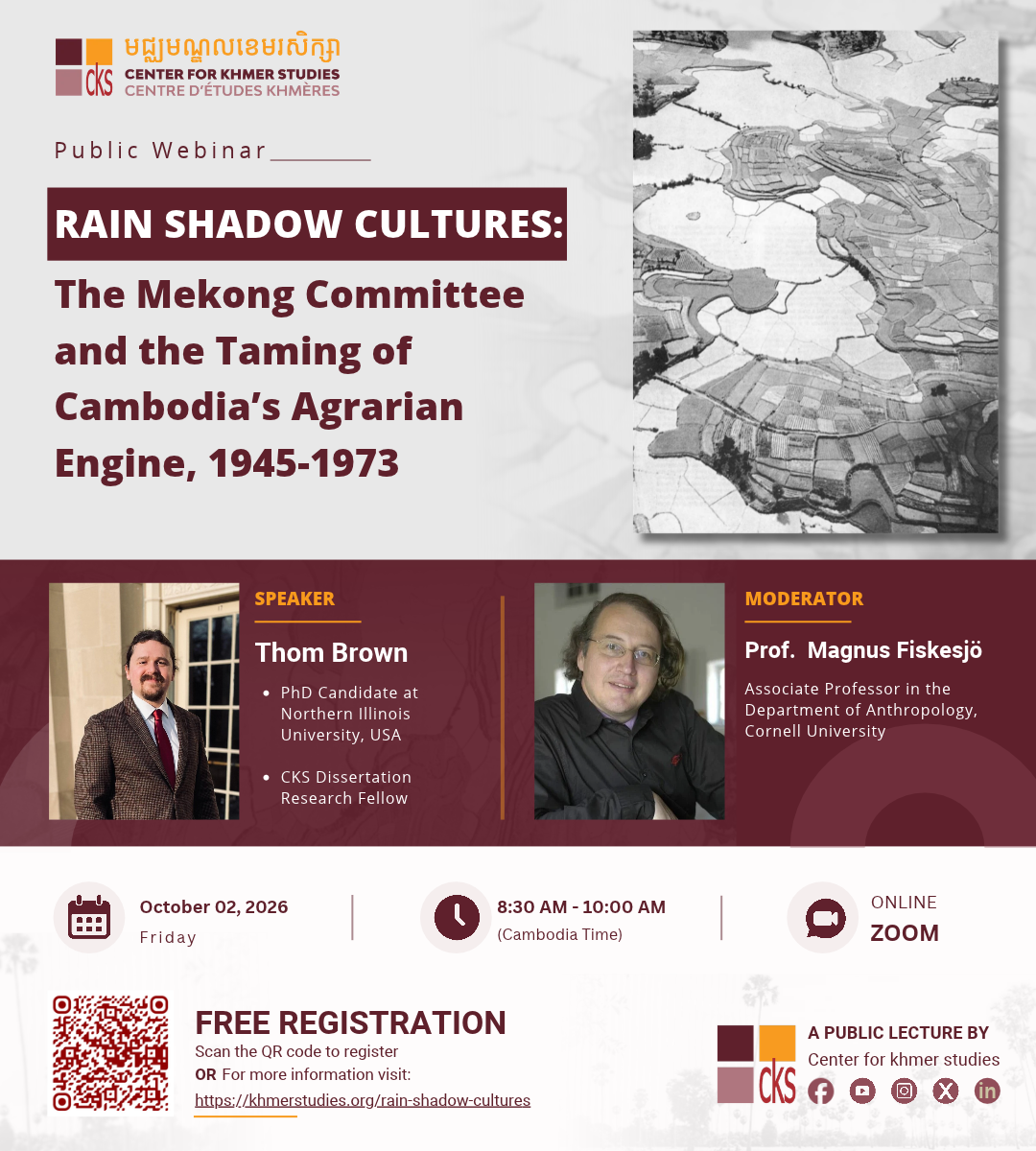
Join the Center for Khmer Studies (CKS) for a talk by Thom Brown, PhD Candidate at Northern Illinois University and CKS Dissertation Research Fellow. This webinar examines the creation of the United Nations-sponsored Mekong Committee and the tensions between development efforts and local understandings of water, floods, and livelihoods.
Abstract:
The monsoon rains have long been held responsible for Cambodia’s agriculture, yet they are not the primary source of the nation’s agrarian prosperity. The fertile floodplains in which Cambodia’s sprawling rice fields lie are situated in a “rain shadow” created by mountain ranges. Rainfall in the affected area is therefore less predictable. The annual alluvial flooding of the Mekong River—so powerful it reverses the direction of the Tonle Sap and forces the lake to swell far beyond its normal size—is the true engine of agricultural fertility. This cyclical flooding has been marked by festivals and rituals for centuries, if not millennia. It occurs frequently in folklore and supports one of the largest, most productive inland fisheries in the world. The floods are a blessing, not a disaster. This presentation explores the creation of the United Nations-sponsored Mekong Committee in 1957 and its attempts to improve flood response, expand agricultural capacities, and commoditize water resources from 1945-1973. Yet Cambodia already had its own cultural responses to a rain shadow environment where droughts and floods coexisted in an ecological rhythm. I analyze the epistemological tensions between teams of technicians, bureaucrats, farmers, fishermen, and corporate surveyors regarding these vital water resources.
About the Speaker:
Thom Brown is a PhD Candidate at Northern Illinois University focusing on global Cold War, Southeast Asian, and Environmental history. A Dissertation Research Fellowship at the Center for Khmer Studies allowed Thom to conduct archival, ethnographic, and site-based research for his dissertation, “A Time to Sow, A Time to Reap: Development and Disaster in Cold War Cambodia, 1945-1973.” Thom is also an Adjunct Professor of History at Huntington University and currently is preparing for publication several journal articles on topics informed by his research in Cambodia, including hydroelectric power and the environment, higher education and the Cold War, and postcolonial livelihoods along ecological and political borders.
About the Moderator:
Professor Magnus Fiskesjö is originally from Sweden. He has long been fascinated with Cambodia and its history, but he visited Cambodia for the first time only in 2012. He received his education in Sweden, Denmark, China, and the US, where he completed his doctoral studies in Anthropology and Asian Studies at the University of Chicago. His doctoral work focused on the history and political anthropology of the Wa people of Myanmar and China. Before earning his PhD, he worked in Sweden’s foreign service and was stationed in Beijing and Tokyo. Later he served as the Director of the Museum of Far Eastern Antiquities in Stockholm, Sweden, one of Europe’s foremost museums of Asian art and archaeology. During this period, he began to take an active interest in the politics of heritage and the issue of repatriations from Western museums.
Registration:
To attend the event virtually, please register here.