
Organizer: The Center for Southeast Asian Studies, University of Michigan - Ann Arbor
Type/Location: Hybrid / Ann Arbor, MI
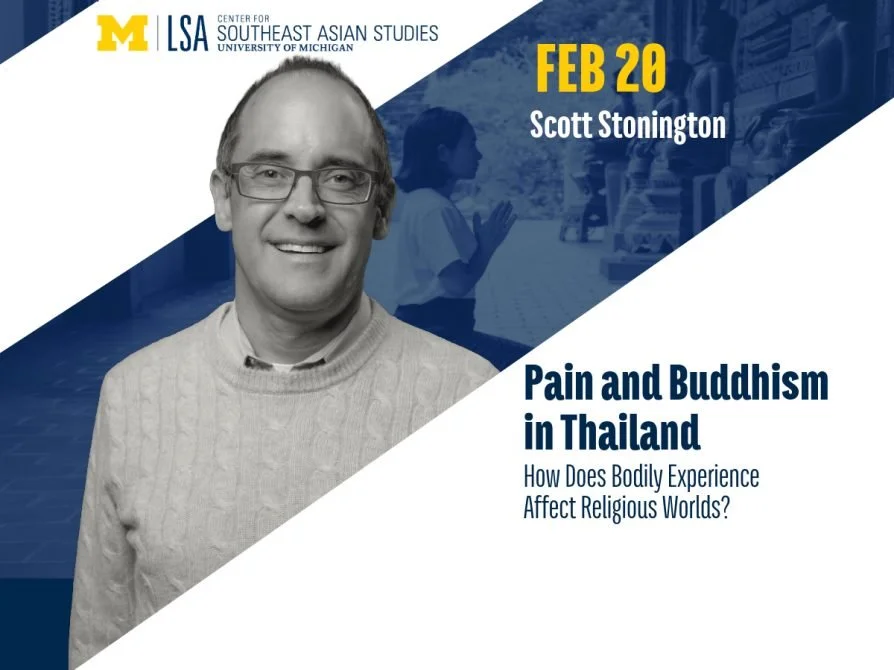
Description:
Thai Buddhism is highly polymorphic, with wide regional and historical variation, with practices ranging from magical power to spirit possession to ethical codes to meditation. People draw from these elements to meet the demands of social, historical, political, and other contexts. In this talk, Stonington asks what assemblages of religious practice might emerge in the face of domineering experiences of the body. Severe pain has been described by phenomenologists as a totalizing experience, making it an ideal test case for this inquiry.
Through interviews and participant observation with people coping with severe pain in Northern Thailand, Stonington argues that a specific set of meditation practices that showed up as orthodox for how they should relate to pain actually made their pain worse, sending them on investigative journeys to assemble novel sets of tools from other practices available to them. Through this isolated individual investigation, his interlocutors surprisingly settled on techniques similar to one another, a kind of emergent locally-heterodox rejection of received wisdom.
About the Speaker:
Scott Stonington is a sociocultural anthropologist and internal medicine physician at the University of Michigan. His first book The Spirit Ambulance, about dying in Thailand, won awards for ethnographic writing and social theory. Current major projects include the politics and experience of pain in Thailand; and the harms generated by time pressure, emotion, and improvisation in the clinical encounter in the U.S.
Registration:
To attend the event in person, please register here.
To attend the event virtually, please register here.