
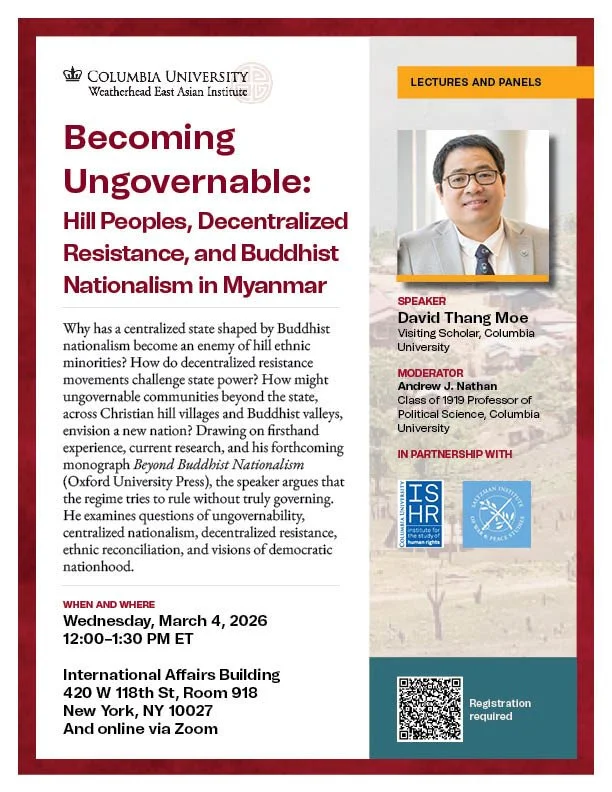
Organizer: Weatherhead East Asian Institute, Columbia University
Type/Location: Hybrid / New York, NY
Description:
Join the Weatherhead East Asian Institute at Columbia University for a talk by Visiting Scholar, Dr. David Thang Moe.
Abstract:
Why has a centralized state shaped by Buddhist nationalism become an enemy of hill ethnic minorities? How do decentralized resistance movements challenge state power? How might ungovernable communities beyond the state, across Christian hill villages and Buddhist valleys, envision a new nation?
Drawing on firsthand experience, current research, and his forthcoming monograph Beyond Buddhist Nationalism (Oxford University Press), the speaker will argue that the regime tries to rule without truly governing. He examines questions of ungovernability, centralized nationalism, decentralized resistance, ethnic reconciliation, and visions of democratic nationhood.
About the Speaker:
David Thang Moe, Ph.D., is a Visting Scholar at Columbia and a Research Scholar in Southeast Asian Studies at Yale, with additional affiliations at Harvard, MIT, Boston University, and University of Connecticut. A leading Burmese scholar, he specializes in Buddhist nationalism, ethnic conflict, and decentralized resistance. He is the author of Beyond the Academy (2024) and the forthcoming Beyond Buddhist Nationalism (Oxford University Press). He has delivered talks globally, met US senators to advocate for Myanmar’s democracy, and been featured in outlets including Voice of America, The Straits Times, and the Yale Journal of Politics.
Moderator: Andrew J. Nathan, Class of 1919 Professor of Political Science, Columbia University
Registration:
To attend the event in person, please register here.
For non-Columbia affiliates, registration is required to access the Morningside campus. After registering you will receive an email with a QR code that must be presented along with a government-issued ID (your name must match exactly the name registered for the event) at either the 116th Street & Broadway or 116th Street & Amsterdam gates for entry. Please register using a unique email address (one email address per registrant) by 4:00 pm on Mar. 3 for campus access
To attend the event virtually, please register here.