
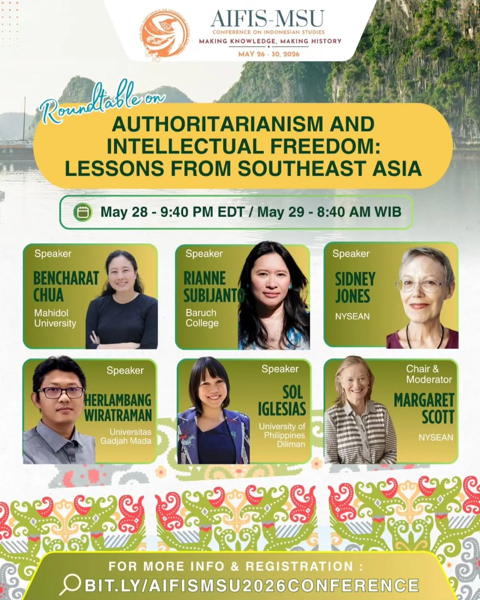
Organizer: The American Institute for Indonesian Studies (AIFIS) and the Michigan State University (MSU) Asian Studies Center
Type/Location: Virtual
Description:
This Roundtable at the AIFIS-MSU Conference on Indonesian Studies will explore the relationship between authoritarianism and threats to academic and intellectual freedom in a way that puts attacks on higher education in the United States in conversation with Southeast Asia.
Our Roundtable gathers young scholars from Thailand, the Philippines and Indonesia to explore how their countries experienced restrictions on academic freedom in the context of democratic decline or rising authoritarianism; what was the sequencing of initial steps and subsequent escalation; and how scholars, students, and university administrators sought ways to fight back. What are the short-term and long-term consequences of restrictive academic policies, not only on universities but on the broader intellectual community? What are useful strategies and tactics to adopt? If the problem is cyclical, are there safeguards that can be put in place in periods of relative openness? What is the experience with collective action? How difficult is it to recover once limits are imposed? More broadly, are there any lessons from the academic world about how autocratization is reversed?
Participants will also discuss how Southeast Asians see the attacks on universities and the cutback in government aid in the U.S., and how these may affect the production of knowledge about Southeast Asia, and the training of future scholars, journalists, policymakers and diplomats.
The Roundtable includes three young scholars who recently founded the Southeast Asian Coalition for Academic Freedom (SEACAF): Bencharat Sae Chua of the Institute of Human Rights and Peace Studies at Mahidol University in Thailand; Herlambang Wiratraman of the Research Center of Law and Social Justice at Universitas Gadjah Mada in Indonesia, and Sol Iglesias of the University of the Philippines-Diliman’s Political Science Department in the Philippines. The following members of the New York Southeast Asia Network’s (NYSEAN) executive committee will be joining: Rianne Subijanto of Baruch College, City University of New York, and Sidney Jones of New York University’s Program in International Affairs. Margaret Scott, a founder of NYSEAN and a journalist with the New York Review of Books, will chair. Pincanny Poluan will serve as MC of the roundtable discussion.
About the Speakers:
Bencharat Sae Chua is a founder and director of the Southeast Asia Coalition for Academic Freedom. She is a lecturer at the Institute of Human Rights and Peace Studies, Mahidol University. Her research interests include the culture of human rights, social movements, and citizenship rights. With the recent political conflict in Thailand, she also focuses on the contention over the meanings of democracy and human rights, and the state of human rights under authoritarian regimes. Bencharat received her PhD in politics from La Trobe University, Australia. She is involved in a project funded by the UN High Commissioner on Human Rights on Youth Politics During the Public Emergency: Case Studies in the Philippines, Indonesia, Cambodia and Thailand.
Sol Dorotea R. Iglesias is associate professor of Political Science at the University of the Philippines, teaching subjects such as Political Analysis, Comparative Politics and Human Rights & International Relations. She has a Ph.D. in Southeast Asian Studies and a M.A. in Political Science from the National University of Singapore as well as a M.A. in International Affairs from the Fletcher School of Law and Diplomacy at Tufts University and a B.A. in Public Administration from the University of the Philippines. She is a member of the Editorial Advisory Board of New Mandala and co-convener of the Women in Southeast Asian Social Sciences (WISEASS). In 2023, she was awarded the Mellon/Scholars at Risk Academic Freedom Fellowship. She was the Inaugural Scholar-in-Residence of the Justice in Southeast Asia Laboratory (JSEALab) at the University of Wisconsin-Madison in 2023. She was selected as a Southeast Asia Research Group (SEAREG) Fellow in 2017. The American Political Science Association’s (APSA) Democracy and Autocracy Committee selected her as an Emerging Scholar in 2020 and she won an APSA Asia Program fellowship and research grant in 2021. She was the first female, first Asian, and first Filipino director of Political and Economic affairs at the Asia-Europe Foundation in Singapore. She is currently writing a book, How a Weak State Governs: The Dynamics of Violence in Philippine Politics, on the central-local interactions that produced violence in the democratic, post-dictatorship period.
Herlambang Perdana Wiratraman is an associate professor and Director of the Research Center for Law and Social Justice (LSJ), at the Constitutional Law Department, Faculty of Law, Universitas Gadjah Mada. He earned an MA in human rights and social development from Mahidol University, Thailand and PhD in Law from Van Vollenhoven Institute, Leiden University Law School. Since 2014, he has been actively collaborating with the Netherlands’ universities for academic research and legal education. The latest project was SLEEI, Strengthening Legal Education in Eastern Indonesia, 2019-2022. He is the founder and chair of the Indonesian Consortium for Human Rights Lecturers (SEPAHAM Indonesia), 2014-2017, and the Southeast Asian Human Rights Studies Network (SEAHRN). He has been initiating the establishment of a progressive alliance for academic freedom in Indonesia (KIKA), of which he is currently an advisory board member.
Sidney Jones is Adjunct Professor of International Relations at New York University, and former Senior Adviser to the Institute for Policy Analysis of Conflict (IPAC) in Jakarta, Indonesia, a non-governmental research organization she founded in 2013. She also serves as a consultant to the UN Office of Counter-Terrorism (UNOCT). She served as Director of IPAC from 2013 to 2021, when she returned to New York. From 2002 to 2013, Jones worked with the International Crisis Group (Crisis Group) in Jakarta, first as Southeast Asia Project Director, then from 2007 as Senior Adviser to the Asia Program. Before joining Crisis Group, she worked for the Ford Foundation in Jakarta and New York (1977-84); Amnesty International in London as the Indonesia-Philippines-Pacific Researcher (1985-88); and Human Rights Watch in New York as the Asia Division Director (1989-2002). During this time, she served as Chief of the Human Rights Office of the United Nations Transitional Administration in East Timor (UNTAET). She has been a Visiting Fellow at Australian National University (1995), the University of California at Berkeley (2012), and Central European Univeristy (2017).
Rianne Subijanto is an Associate Professor in the Department of Communication Studies at Baruch College and the Graduate Center of The City University of New York. As a media historian of Southeast Asia specializing in Indonesia, her research explores global communication in the context of nineteenth- and twentieth-century colonialism and capitalism, showing how technologies, infrastructures, and communicative practices are deeply entangled with power, labor, and ecology. Broadly, her work contributes to debates on democratic communication, global media, and the critical theory and history of capitalism, while foregrounding struggles for universal emancipation as well as social and environmental justice. Her first book, Communication against Capital: Red Enlightenment at the Dawn of Indonesia (Cornell University Press, 2025), examines how enlightenment ideals and communist ideas intersected in shaping the emancipatory spirit that fueled the pergerakan merah, the anticolonial “red movement” of 1920s Indonesia.
Registration:
To attend the event virtually, please join the zoom meeting here.