
Organizer: Sulo: The Philippine Studies Initiative at NYU
Type/Location: In Person / New York, NY
Description:
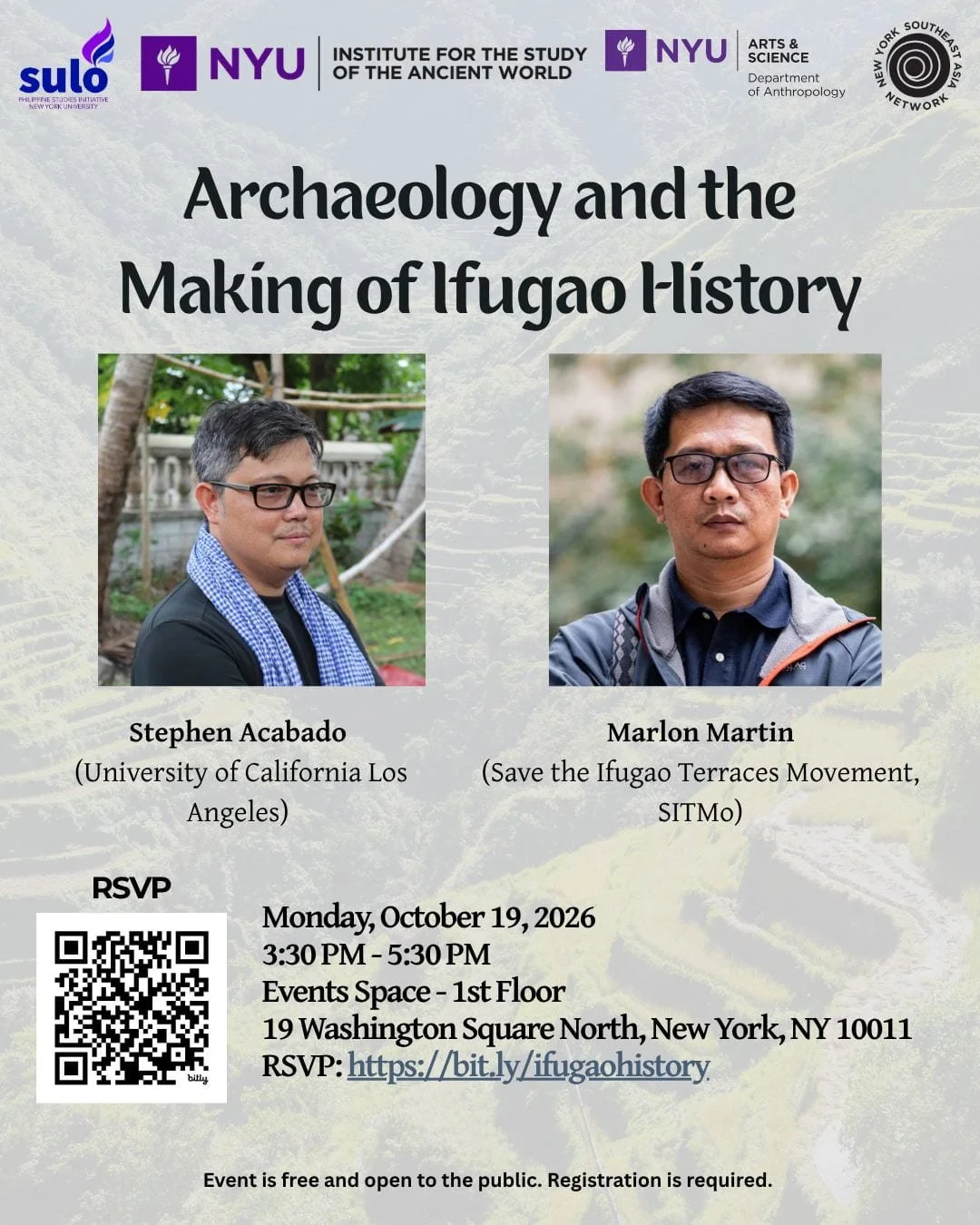
Who has the authority to tell Ifugao history, and what changes when communities take part in that work? This conversation draws from archaeology in Ifugao to examine how knowledge about the past is produced and shared. Research has challenged long-held claims about the age of the rice terraces and has shown how community knowledge can redirect archaeological interpretation. It has also changed how archaeology is practiced. Community members do not enter the process only after research questions have been set. Their knowledge can reshape how archaeologists understand the past. The discussion also considers what happens when archaeological findings return to the communities from which they came. Ifugao provides a case for thinking about archaeology as a shared practice, one in which scholars and communities negotiate how the past is understood and how history is told.
About the Speakers:
Stephen Acabado is a Professor of Anthropology at the University of California, Los Angeles. Acabado is a strong advocate of an engaged archaeology where descendant communities are involved in the research process. His archaeological investigations in Ifugao, northern Philippines, have established the recent origins of the Cordillera Rice Terraces, which were once thought to be at least 2,000 years old. His work revolves around agricultural systems, indigenous responses to colonialism, subsistence shifts, landscape archaeology, and heritage conservation. He directs two archaeological projects in the Philippines: the Ifugao Archaeological Project and the Bicol Archaeological Project. In 2020, he is collaborating with Taiwanese colleagues in launching the Taiwan Indigenous Landscape and History Project. He received his PhD and MA in Anthropology from the University of Hawaiʻi-Mānoa and his BA in Anthropology from the University of the Philippines-Diliman.
Marlon M. Martin is the executive director of the Save the Ifugao Terraces Movement (SITMo), a community-based organization dedicated to the conservation of the UNESCO-listed Ifugao Rice Terraces. A passionate advocate for Indigenous heritage and community empowerment, Martin has been instrumental in bridging local knowledge and academic research. His leadership in the Ifugao Archaeological Project has redefined how heritage research can be co-created with communities, helping to challenge long-standing misconceptions about Ifugao history. Through initiatives like the Preserving Legacies program, Martin has emphasized the centrality of community participation in developing sustainable strategies for cultural preservation and revitalization. With over two decades of experience in heritage management, Martin has contributed to national and international dialogues on Indigenous knowledge systems, climate adaptation, and the intersections of cultural and environmental sustainability. His work exemplifies the transformative potential of community-driven approaches to archaeology and heritage conservation.
Registration:
To attend the event in person, please register here.