Who Gets Remembered as American? Vietnamese Refugees and the Fight for Public Memory Through Art (Commentary)
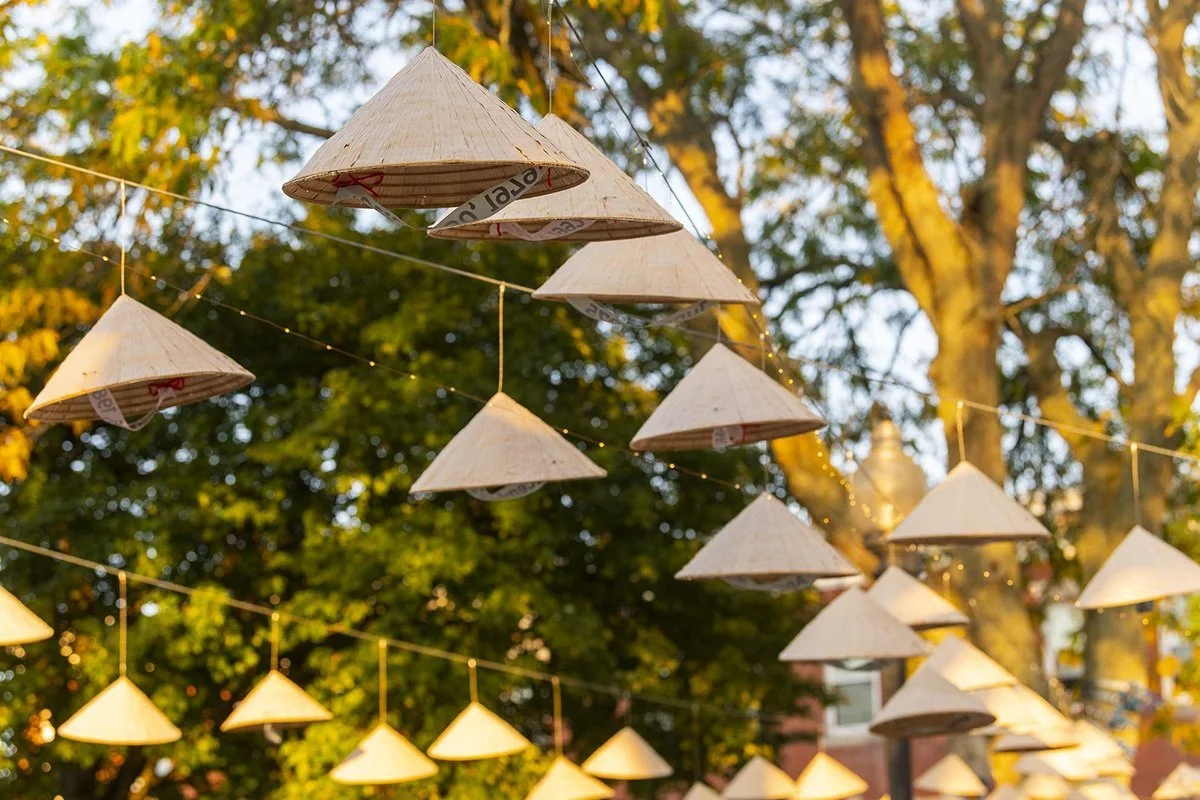
A closeup of conical hats displayed in Journey of Light: A 1975 Memory Field, temporary installation by Ngoc-Tran Vu, 2025 | Photo: Lee-Daniel Tran.
In an article for Nonprofit Quarterly, Ngọc-Tran Vu asserts the importance of public art in honoring the Vietnamese American refugee community in the Northeast.
Public art signals what a democracy chooses to remember and, just as importantly, who it overlooks.
Walk through many US cities, and Vietnamese American life is visible in certain ways. You can find us in restaurants, markets, nail salons, temples, churches, community centers, festival banners, and small business corridors. We share this with many refugee communities––from Cambodian, Lao, and Hmong families displaced by wars in Southeast Asia––to Somali, Afghan, Iraqi, Haitian, Bosnian, and other communities who have rebuilt homes after rupture. Our labor, food, rituals, languages, and family histories are woven into the everyday life of neighborhoods, even when our stories of displacement and survival remain harder to encounter in public memory.
Compared with the scale of public memorials dedicated to war, military service, and other established civic narratives, Vietnamese American refugee stories remain much harder to encounter, particularly in the Northeastern states. Public art matters because it gives displaced communities a visible place to remember, and it gives the wider public a way to encounter histories of war, refuge, survival and belonging.
That absence matters.
The Vietnam War is one of the most publicly remembered wars in the United States, and Maya Lin’s Vietnam Veterans Memorial in Washington, D.C., remains one of the most recognized public artworks of that memory. Its history also reminds us that memorials are never simple. Even this now-beloved landmark was once highly controversial, revealing how difficult it can be for a nation to decide how grief, responsibility, service, and loss should be held in public. US veterans’ losses deserve honor, yet at the same time, if public memory of the war stops with American military loss, the story remains unfinished.