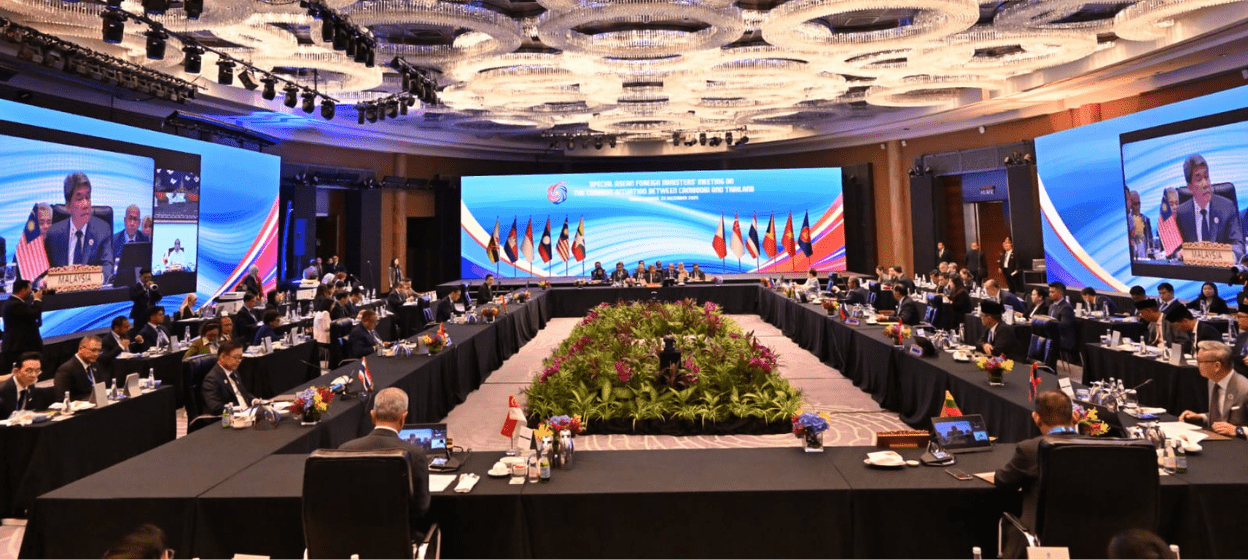
On December 22, 2025, Foreign Ministers of ASEAN Member States participated in the Special ASEAN Foreign Ministers’ Meeting (SAMM) on the Current Situation between Cambodia and Thailand, in Kuala Lumpur, Malaysia | Photo by Ministry of Foreign Affairs Malaysia / ASEAN Secretariat via Flickr
In an article for Fulcrum, Melinda Martinus and Fannesa Adisty Laksmita assert that ASEAN’s strength lies in convening and facilitating dialogue. However, without follow-through, different parties’ political will, and sufficient leverage, ASEAN’s mediation efforts will struggle to deliver results.
Today’s increasingly contested geopolitical environment is placing new strains on ASEAN’s longstanding diplomatic practices. As one of the world’s most established regional organisations, ASEAN has traditionally relied on quiet diplomacy, non-interference, consultation and consensus-building to manage differences among its diverse membership. These principles also shape its approach to conflict mediation, which favours dialogue and facilitation over direct intervention.
This approach can be effective when parties are willing to engage, but whether it produces concrete results depends on their willingness to cooperate and, in some cases, on ASEAN’s ability to influence their behaviour. Three cases illustrate different constraints and are worth examining: Indonesia’s use of shuttle diplomacy since the 1980s shows the gap between agreement and implementation; the ASEAN Special Envoy mechanism on Myanmar shows the limits of political will; and the ASEAN Chair’s role in the recent Cambodia-Thailand conflict shows the importance of leverage.
Indonesia’s shuttle diplomacy is one of the clearest manifestations of ASEAN’s preference for quiet engagement. In the late 1980s, then Foreign Minister Mochtar Kusumaatmadja travelled to Ho Chi Minh City to bring Cambodian factions and external parties together, culminating in the Jakarta Informal Meeting. This series of meetings contributed to the 1991 Paris Peace Agreements, which marked the end of the Cambodian-Vietnamese War. A similar approach was used again in 2012, when ASEAN foreign ministers failed to issue a joint communiqué over disagreements on the South China Sea dispute. In response, then-Foreign Minister Marty Natalegawa travelled to several ASEAN capitals within 36 hours to engage member states individually. His efforts contributed to the adoption of the ASEAN Six-Point Principles on the South China Sea, which reaffirmed respect for international law and the peaceful resolution of disputes.
However, shuttle diplomacy has been less successful when agreement had to be turned into action. In 2011, Indonesia helped mediate the Thailand–Cambodia border dispute by facilitating talks and seeking to establish an ASEAN role in managing the conflict. Although both sides agreed in principle to ASEAN observers, the mission stalled over its terms of reference, particularly Thailand’s conditions on the withdrawal of Cambodian troops.