Timber, Tycoons, and the Making of Sarawak Politics
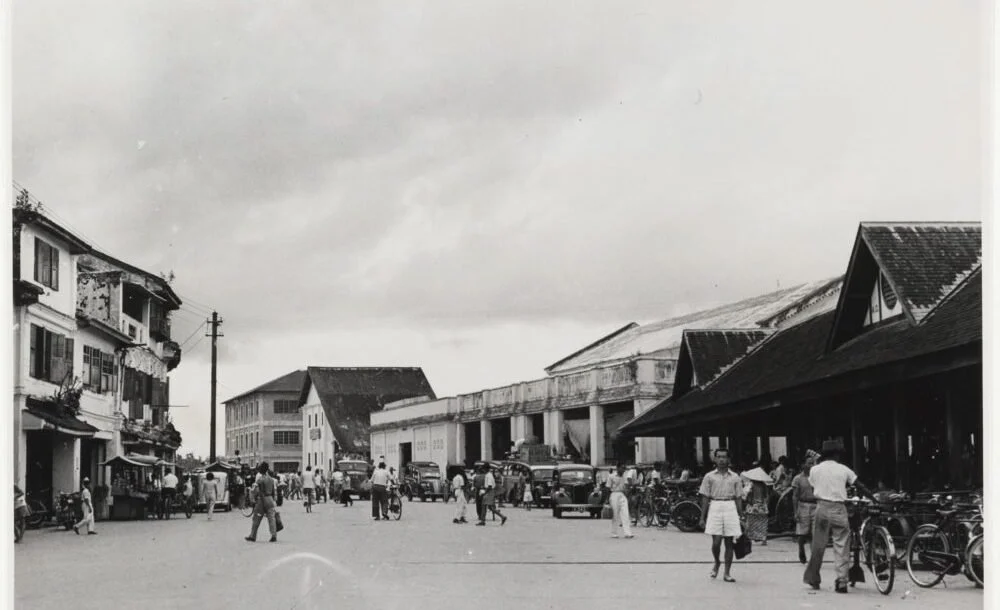
Central Kuching in 1951 | Photo: Shell Photographic Unit/Leiden University Libraries
In New Mandala, Meredith L. Weiss reviews Ethnic Chinese Politics in East Malaysia, 1945–2018: From Timber-tycoons to Sarawak Regionalism, written by Ngu Ik Tien. She asserts that Ngu’s recent publication provides a unique and provocative lens on the political landscape of Sarawak.
In this long-awaited book, Ngu Ik Tien, a senior lecturer in Chinese Studies at Universiti Malaya in Kuala Lumpur, offers a cogent and compelling account of politics in a Malaysian state with a political history like none other: Sarawak.
The account complements a mere handful of book-length studies of the state’s politics—most notably James Ung-Ho Chin’s 1996 Chinese Politics in Sarawak: A Study of the Sarawak United People’s Party and Faisal S. Hazis’s 2012 Domination and Contestation: Muslim Bumiputera Politics in Sarawak (like Ngu’s volume, both began their lives as PhD dissertations)—and a still-sparse number of (generally older) works of (now, if not initially) history, anthropology, or economics (e.g. by Daniel Chew, James C. Jackson, Amarjit Kaur, Craig Lockard, Michael Leigh, Peter Searle, T’ien Ju-K’ang).
Particularly as federal “Malayan” parties woo Sarawak’s (and neighbouring Sabah’s) parliamentary seats increasingly aggressively to cement potential winning coalitions, why and how politics in this state differ from peninsular norms is all the more imperative for Malaysians and Malaysia-watchers to understand.
Like Faisal, in his study of Sarawak’s also-complex Malay/Melanau politics, Ngu frames her analysis in terms of Joel Migdal’s “state in society” approach, albeit proposing also a novel take on revamped consociationalism in Malaysia. At its most basic, Migdal’s take is that state and social forces cannot be disentangled fully; the latter both contest and share authority with the state, including in the functioning of personalised and/or partisan political machines. The state is embedded in society, not least via the participation of local strongmen across society, parties, and government. Moreover, disaggregating federal, state, and local tiers of government reveals how each is “intertwined with society”, which itself consists of “aggregated segments” (p. 4–5).
Meredith L. Weiss is Professor of Political Science in the Rockefeller College of Public Affairs & Policy at the University at Albany, State University of New York. She has published widely on political mobilization and contention, the politics of identity and development, and electoral politics in Southeast Asia, with particular focus on Malaysia and Singapore. Her latest book, The Roots of Resilience: Authoritarian Acculturation in Malaysia and Singapore, is available from Cornell University Press. She co-edits the Cambridge University Press Elements series on Southeast Asian Politics and Society. She is the co-chair of the SUNY/CUNY Southeast Asia Consortium, is a member of the New York Southeast Asia Network (NYSEAN), and has been a member of New Mandala's editorial advisory board.