Officially Unofficial: The Black Market in Ne Win’s Burma
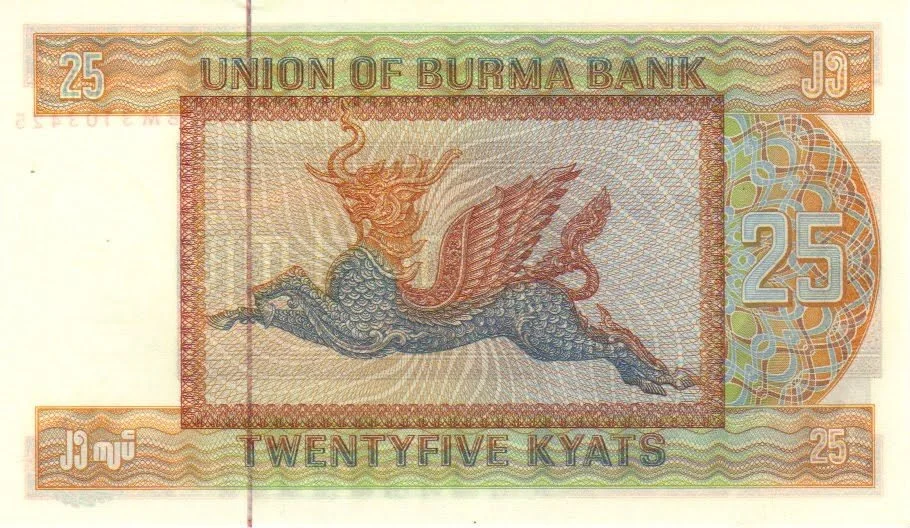
The reverse side of a 25 kyat bank note from the Union of Burma (now Myanmar) issued in 1972 | Wikimedia Commons
In an article for New Mandala, Andrew Selth asserts that the socialist economy envisioned by the Burmese military regime that ruled from 1962 to 1988 existed only in propaganda.
During the 1970s, anyone standing at the top of Sule Pagoda Road in Rangoon (now Yangon) on a weekday morning could witness a curious phenomenon. After the “Down” train from the southern city of Moulmein (now Mawlamyine) had pulled into nearby Central Railway Station, dozens of women and a smaller number of men would alight, laden down with a wide assortment of bundles and boxes. Some would head straight to the taxi stands, to hire one of the ubiquitous little Mazdas known as lei bein kar (literally “four wheels car”) waiting there. Others would shoulder their burdens and head off on foot, trudging westwards along Bogyoke Aung San Road.
This ritual occurred even though many passengers had already unloaded the bulk of their luggage by throwing it off the train at various points along the railway track, before it arrived at Central Station. By prior arrangement, their jetsam was collected by friends and collaborators who were lying in wait. In this way, those on the train reduced the chances of being detained by Customs Department officials wanting to enforce the wonderfully named 1963 Law to Protect the Construction of the Socialist Economy from Opposition. Other passengers would have already paid bribes to conductors and railway policemen to ensure a quick getaway when the train pulled into the station.
Whether they arrived by train or were carrying goods picked up elsewhere, the ultimate destination of all these travellers was the St John’s Bazaar, situated near the intersection of St John’s Road (now Min Yay Kyaw Zwa Road) and Prome (or Pyay) Road. There, about 500 shelters and makeshift wooden stalls marked the city’s main hmaung kho zei, (literally “shady market”). By convention, it was considered neutral ground, where traders could display illicit wares relatively free from official harassment. Most items on sale had been smuggled into Burma (now known as Myanmar) from Thailand. There was also contraband from other places, as well as goods “diverted” from official outlets, such as the People’s Cooperatives, where the shelves were more often than not left bare.