Navigating Our Future Together? The Philippine Chairmanship in a Year of Strategic Tension
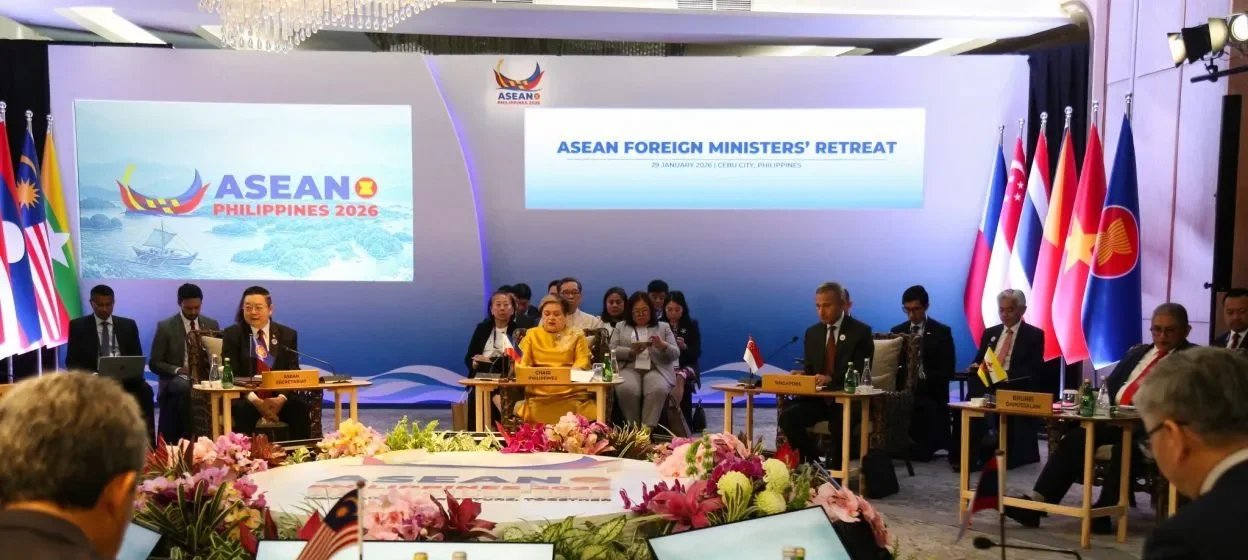
Philippine Foreign Minister Theresa Lazaro delivers a speech during the ASEAN Foreign Ministers' Retreat in Cebu City on January 29, 2026 | Photo by Jacqueline Hernandez / POOL / AFP
In an article for Fulcrum, Joanne Lin and Aries A. Arugay assess the first quarter of the Philippines’ ASEAN chairmanship and the challenges that still lie ahead.
When the Philippines assumed the ASEAN chairmanship on 1 January 2026 under the theme “Navigating Our Future, Together”, expectations were high within ASEAN that Manila would steer ASEAN through a year marked by strategic uncertainty and accumulated regional pressures. The organisation continues to face political crises in Myanmar, persistent tensions in the South China Sea (SCS) and a broader environment in which the second Trump administration and geoeconomic competition continue to test ASEAN unity. Two months into the chairmanship, early meetings and diplomatic engagements offer initial signals of how Manila is positioning itself within these structural constraints.
The Philippine chair has focused on continuity. The ASEAN Foreign Ministers’ Retreat in Cebu in late January was an early test on forging unity on sensitive issues, with Myanmar at the centre of discussions. There, Manila reiterated established ASEAN positions, including continued reference to the Five-Point Consensus and the restriction of high-level representation by the Myanmar military authorities. In her capacity as Special Envoy of the ASEAN chair, Foreign Secretary Maria Theresa P. Lazaro’s visit to Myanmar on 6 January 2026 made clear after her visit that ASEAN would not recognise the recent electoral process as yet, reinforcing the grouping’s position that political developments in Myanmar must move towards inclusive dialogue and cessation of violence. While engagement with the military leadership prompted criticism from regional observers, the visit reflected ASEAN’s long-standing approach of dialogue without endorsement.
This dual-track posture reflects Manila’s effort to bridge differing views within ASEAN on the balance between political pressure and continued engagement with Naypyidaw. Lazaro’s visit was not intended to produce a political breakthrough. Rather, Manila appears to be signalling that its chairmanship will prioritise managing escalation risks and preserving ASEAN’s collective position rather than forcing an expedited political outcome.