By Difa Farzani
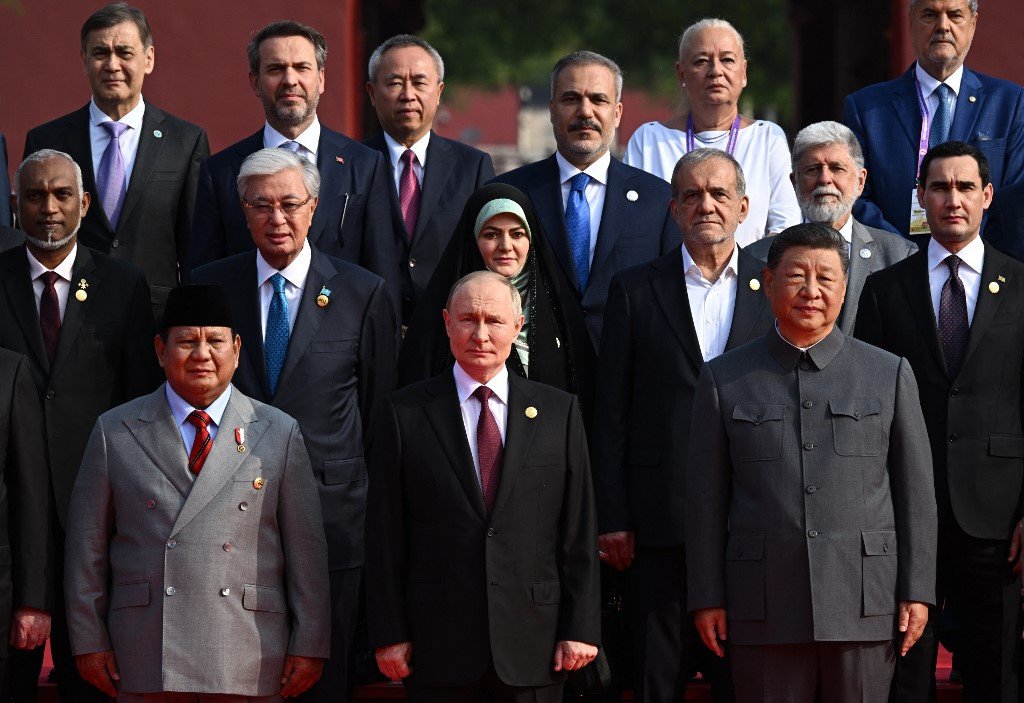
Indonesian President Prabowo Subianto, Russian President Vladimir Putin, Chinese President Xi Jinping and heads of foreign delegations pose for a family photo before a military parade marking the 80th anniversary of the end of World War Two, in Beijing, China, on September 3, 2025 | Photo bySergey Bobylev via AFP
Democracy is not collapsing because people have stopped valuing freedom. It is collapsing because insecure leaders are rewarded for looking tough, even when they govern poorly. Across the world, the “strong leader” has re-emerged as a political ideal, even though political psychology shows that what looks like confidence is often a performance born of insecurity. In a period marked by geopolitical rivalry, economic anxiety, and declining trust in institutions, leaders project toughness not because they feel powerful, but because they fear losing control. Indonesia, now at a pivotal stage in its democratic development, must pay close attention to this trend.
As global insecurity rises, so does public demand for leaders who appear unshakeable and this creates dangerous incentives. Indonesia must resist importing or reproducing the aesthetics of performative toughness, because such performances distort public judgment, weaken accountability, and can quietly erode democratic norms.
Freedom House reports that the world is now in its 16th consecutive year of democratic decline, with authoritarian setbacks outnumbering improvements by a ratio of 60 to 25. Two in five people now live under regimes classified as “Not Free,” the highest proportion in more than two decades. In this environment, it is no surprise that strongman figures dominate political imagination: their style travels easily in an insecure world.
Behavioral research helps explain why. An American Psychological Association study across seven experiments and more than 2,000 participants found that people who see the world as a “competitive jungle” consistently rate antagonistic leaders as more competent, even when their actions are harmful. In one experiment, respondents with strong competitive worldviews rated hostile managers 0.55 points higher in competence and 0.53 points higher in leadership effectiveness (on a 5-point scale). Under uncertainty, aggression becomes a substitute for competence. This matters for Indonesia: when citizens are primed to admire toughness, democratic qualities like deliberation or transparency fade from view.
Political science reinforces these psychological patterns. A cross-national study using Gallup World Poll data from more than 140 countries shows authoritarian governments appear more popular, averaging 54 percent approval versus 43 percent in democracies but this advantage reflects narrative control, not genuine endorsement. Their approval peaks only when tightly managed elections bring a new leader, generating an approximately 18-20-point surge, compared to a four-point rise when incumbents stay. Once media freedom is accounted for, the popularity gap disappears: a one-standard-deviation drop in press freedom yields a six-point jump in approval, not because governance improves, but because fewer failures are visible. Popularity in these systems is curated, not earned.
Globally, insecurity fuels the rise of such leaders. Erdoğan’s shift from reformer to power consolidator reflects Turkey’s geopolitical anxieties. Putin’s choreographed toughness masks fears of national decline. Duterte’s violent rhetoric resonated with Filipinos worried about disorder. Kagame and Museveni frame concentrated authority as essential for stability. Different contexts, same psychology: rising insecurity heightens demand for leaders who look tough.
Indonesia is not insulated from these global forces. Scholars indicates that the rise of “authoritarian populist” aesthetics in Indonesia is not merely imported from abroad, but rather actively engineered domestically. Rakhmani and Saraswati (2021) show how Indonesia’s campaign industry such as consultants, media strategists, and coordinated online networks who actively constructs strongman personas, allowing images of decisiveness to overshadow institutional performance.
This dynamic helps explain why certain political displays resonate strongly. When Prabowo Subianto appeared alongside Vladimir Putin, Xi Jinping, Kim Jong Un, and Kassym-Jomart Tokayev at a military parade on September 3, many Indonesians celebrated it as proof of Indonesia’s rising global stature. Yet behavioral research warns that such imagery subtly shapes public expectations. If antagonistic displays are easily mistaken for competence, moments like this can normalize leadership grounded more in dominance than in democratic accountability.
The Guriev-Treisman findings sharpen this caution. Indonesia is not authoritarian but borrowing the optics of states that tightly manage information blurs the line between strategic diplomacy and performative alignment. As curated political images circulate domestically, detached from institutional nuance, they reshape what citizens perceive as “strong leadership.”
Indonesia’s democracy remains resilient, and public support for democratic principles is strong. Rising admiration for firm leadership does not signal a rejection of democracy; it reflects uncertainty about what effective leadership looks like in a polarized world. However, this is precisely how democratic backsliding often begins, subtly through shifting expectations and aesthetics rather than overt institutional rupture. Indonesia has long benefited from leaders who pair firmness with humility and decisiveness with democratic principles. As performative toughness spreads globally, Indonesia must avoid confusing the appearance of strength with its substance.
If insecurity can cross borders, then so can the resolve to choose leaders and institutions strong enough to withstand it. Indonesia still has that choice, and we must choose carefully.
Difa Farzani is a NYSEAN member and MPA student at the NYU Robert F. Wagner Graduate School of Public Service.