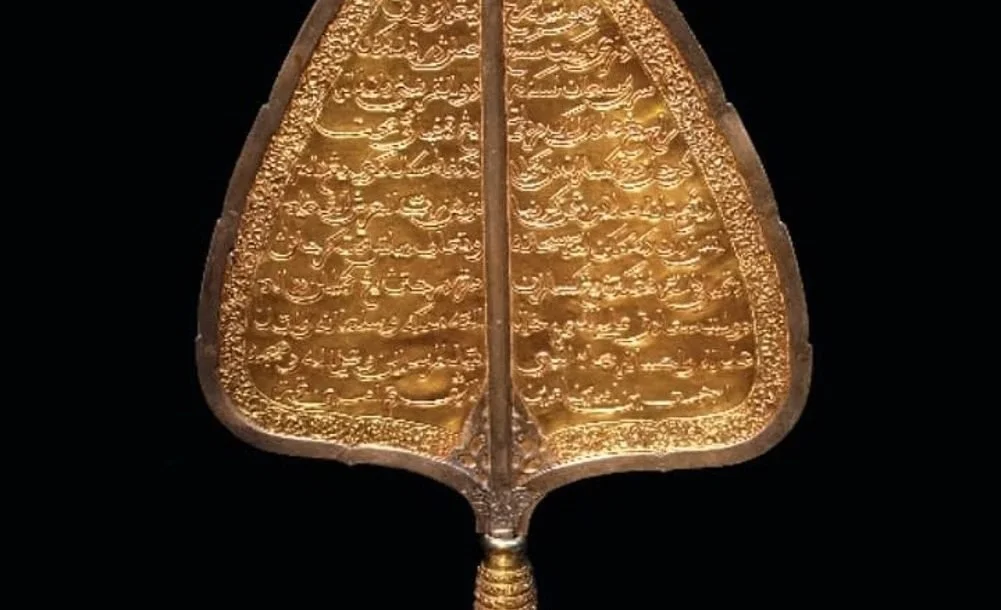
The Cogan, royal regalia of the Riau-Lingga Court | Image: Museum National Indonesia
In this article published by NYSEAN Partner New Mandala, Myra Mentari Abubakar writes about two women and the blind spots of the national history of the Malay world: Engku Puteri Raja Hamidah (1774-1844) and Khatijah Sidek (1918-1982).
In October 1822, Dutch troops landed on Pulau Penyengat, a tiny island south of Singapore in the Riau archipelago. The island had been granted to Engku Puteri Raja Hamidah upon her marriage to Sultan Mahmud Shah III, whose death in 1811 triggered a decade-long succession crisis that became a stage for the Anglo–Dutch contest for influence within the Riau–Johor sultanate.
These two colonial powers faced the common challenge of legitimising the rule of the different princes whose coronations as Mahmud Shah’s successor each had helped engineer. By court custom, possession of a fan-shaped item of royal regalia known as the Cogan was necessary for the lawful installation of a sultan. As custodian of the Cogan, Mahmud Shah’s widow, Engku Puteri, had an important role in determining the legitimacy of a succession, and thus held substantial political clout.
It was the goal of securing the Cogan on behalf of their favoured sultan that brought Dutch forces to Engku Puteri’s island base in 1822. She would not surrender the regalia, so colonial troops took them by force. Though her refusal could not prevent the intervention, it denied the succession the legitimacy that the Dutch sought from the existing court.