October 22 – 23, 2026, The Robert F. Wagner Graduate School of Public Service, New York University
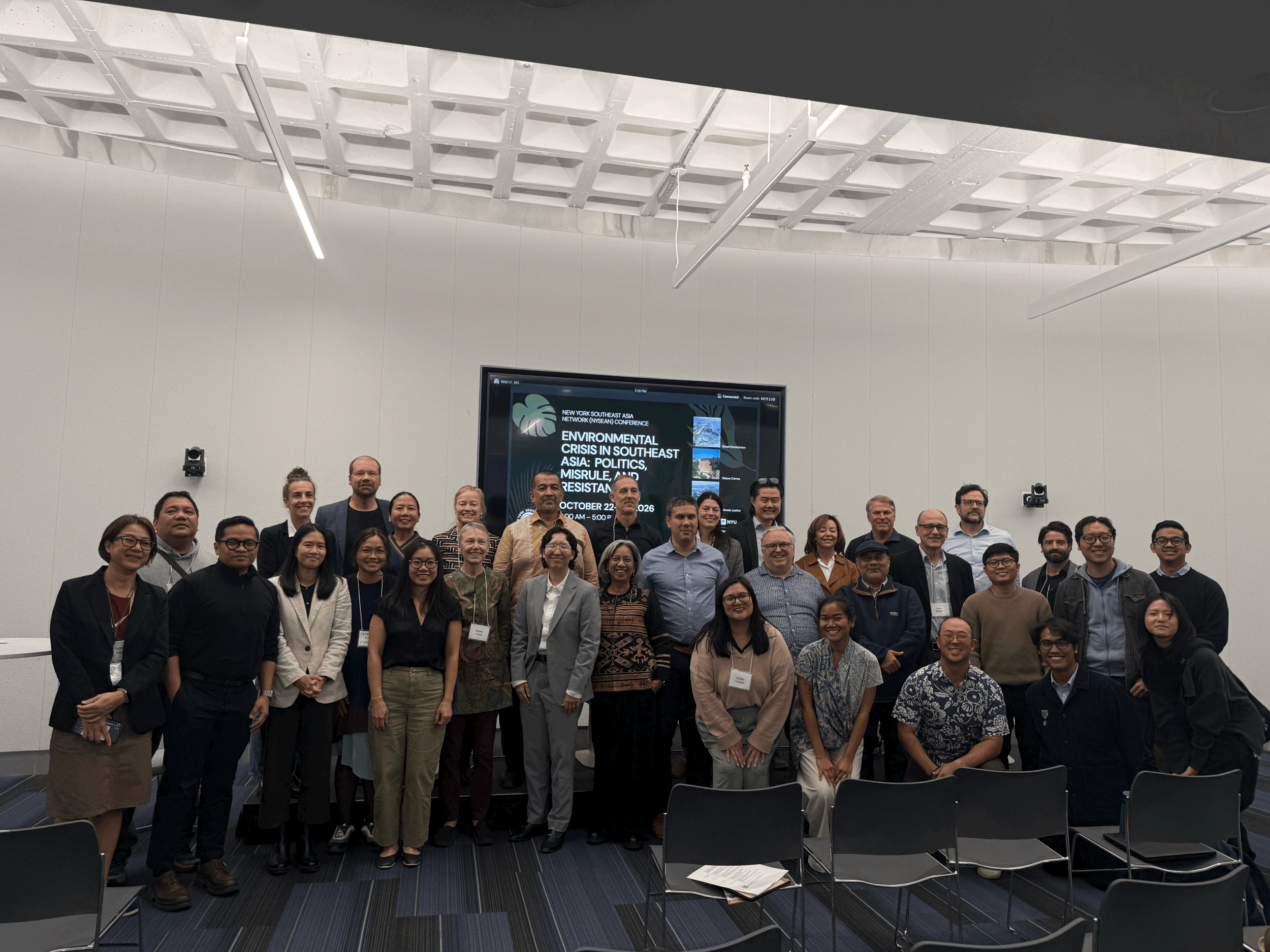
NYSEAN’s conference was designed to bring together scholars and practitioners working on Southeast Asia to examine the politics of the environmental crisis across a region where socio-ecological ruptures are not aberrations but products of longstanding structures of extraction and governance failure. The goals were to strengthen contacts between activists and academics focusing on mainland and maritime Southeast Asia, understand the roots of the crises all are facing, and examine the political conditions necessary to advance climate action and foster social and environmental justice. The conference was open to the public but most of the meaningful discussions took place among the participants themselves.
The focus was on extractive industries, especially nickel mining; palm oil; and hydropower, all increasingly legitimized through the language of green transitions and climate finance. Speakers examined how states used green energy arguments to justify dispossession and displacement and how communities were fighting back, where it was politically possible to do so. Erik Harms gave a moving keynote speech, showing how in Vietnam, where space for protest is almost non-existent, activists used art and poetry to challenge the state’s felling of shade trees in urban spaces.
Several themes ran through the discussion. One was the importance of working at a local level when the prospects for change at a national level are grim. One model was a case study presented of Sigi district in central Sulawesi, Indonesia. With an energetic district head, it has become the only district in the province that has resisted mining of critical minerals through an alliance of NGOs, customary leaders and local authorities and businesses.
A second theme was the danger of treating China as an entirely negative presence, especially when the countries of Southeast Asia are practicing “polyalignment,” or trying to avoid taking sides in US-China rivalry. Several speakers gave examples of the need to convince China or Chinese companies on the importance of consultation with local communities when major extractive projects are involved, and how in some cases, targeted training of company staff could pay off.
Another theme explored was how treating democracy and authoritarianism as a black-and-white dichotomy was unhelpful in trying to identify where climate action was possible. In some cases, the issue was less one of a one-party system vs democracy than of state capacity. In some more open societies, such as the Philippines or Indonesia, fossil fuel dependence was hard to break because the vested interests of entrenched oligarchic elites, whereas in China, the state had both the capacity and the will to make positive environmental decisions on a massive scale and carry them out, as evidenced by the reforestation of desert areas in Inner Mongolia or the “crowd-sourced pollution control” made possible by China’s use of surveillance technology to encourage citizens to report pollution sites along rivers – not to mention its championing of solar power. The problem was that when China invested overseas in resource extraction, environmental concerns tended to evaporate. Speakers emphasized that Chinese capital adapts and responds to local conditions, and in Southeast Asia those local conditions are often weak rule of law and deteriorating democratic guardrails.
Several speakers noted how the narrative of green energy transition made resistance harder, because buyers saw non-fossil fuels as inherently good. They did not see the land grabs involved in palm oil in Indonesia, the displacement and salinization caused by dams along the Mekong, or the destruction caused by nickel mining for electric vehicles, even as batteries are relying less and less on nickel. The environmental damage has been done, and is expected to accelerate. While ‘green’ narratives attached to dirty extractive practices have created leverage for new forms of supply chain activism—international action against European buyers of EV batteries containing Indonesian nickel has made some headway—speakers felt such efforts were no replacement for effective democratic institutions at the local level.
The difficulty of challenging the narrative of green transitions means that collecting hard data becomes all the more important. Several of the speakers from the Mekong region noted the importance of data generated by the Stimson Center in Washington, DC, and how useful this was to grassroots activists trying to persuade politicians or local leaders of the harm done by hydropower projects. This was one area where collaboration of academics and activists was critical. Hard evidence on palm oil, critical minerals mining and timber has already been enough to warn away some European buyers of these products. Increasingly sophisticated tools for identifying their exact source can also be useful for advocacy for supply chain interventions. Some of the academics also shared information on databases with their NGO colleagues, including one that Jojo Nem Singh’s Critical Minerals Policy Lab has on Chinese investments in resource extraction.
A lively discussion took place around the role of crises caused by economic collapse or natural disasters and how these could contribute to strengthening the will for action. In Aceh, Indonesia and the Philippines, natural disasters exacerbated by corruption led to short-term gains (arrest of corrupt politicians or revocation of a mining license or two), but no political change. Some thought the key to getting change was involvement of the region’s middle classes as happened during the 1997-98 economic crisis, but it would take another crisis to get that to happen.
Ward Berenschot’s study of some 544 palm oil conflicts in Indonesia showed that the few in which the farmers “won” involved good leadership, well-established community organizations, and perseverance over many years, often over a decade.
The role of law and lawsuits came up in many discussions, as a means of strengthening and challenging elites. On the one hand, “legal corruption” is widespread throughout the region as companies and politicians use laws, some of them leftover from colonial days, to justify land grabs or arrests of activists on the grounds of everything from defamation to illegal possession of weapons (for example, arresting protesting palm oil workers for carrying machetes which they need for their work). On the other hand, some activists have used lawsuits effectively to gain compensation for land seized or damaged or to impose fines on the companies involved – though a successful lawsuit doesn’t necessarily entail the return of land seized.
Another common theme focused on how states are capturing new pathways of capital flows with the advent of the green transition, much like previous economic transitions. Political elites in Thailand, for example, have hijacked the country’s energy sector to resist a transition away from carbon-based fuel, and any tilt towards solar and other green energy sources is being consolidated by the same elites who have effectively bought off governing parties. In Myanmar, the long-running civil war that the 2021 military-led coup supercharged, further entrenched the military and its aligned militias in the country’s illicit resource economy, including rare earths and scam centers. Myanmar’s increasingly blurred line between criminal organizations and governments makes successful advocacy all the more difficult – but also makes documenting the links all the more important as these activities continue to destabilize the entire region.
Under the heading of “working with the cards you’re dealt rather than the ones you want,” both Jojo Nem Singh and Frances Seymour noted the importance of understanding the political context and realizing where some action was possible. Seymour made a compelling case for carbon trading on a “jurisdictional” – i.e. province-or state-wide rather than a project basis – using successful cases from Latin America, while Art Blundell’s countercase of “carbon cowboys” and corrupt use of carbon-trading from Liberia provided a cautionary note. Again, success depended on understanding where there was room to maneuver, even with rightwing governments.
Many people noted the transnational nature of many of these climate issues but virtually no one was optimistic that change was going to come through multilateral institutions such as ASEAN or the Mekong River Commission. One participant suggested a new kind of Bandung conference, resembling the 1955 gathering that Soekarno organized that gave birth to the Non-Aligned Movement, but it was clear that with the current political leadership in place, no heads of state meeting was going to produce positive results, and meetings of NGOs or others have no leverage. Thailand had been the hope for a progressive political movement, but now the “orange parties” (Future Forward, Move Forward and the People’s Party) were burned out. The formation by NGOs in Indonesia of a “shadow cabinet,” electing individuals they regard as better qualified than the real ministers and suggesting alternative policies, may prove to be a useful advocacy tool but it is too early to tell.
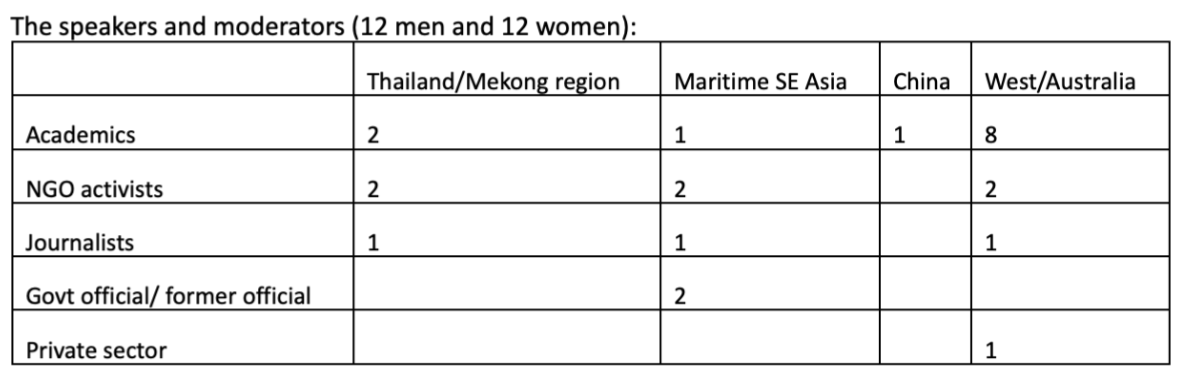
In summing up the two days of discussion, Erik Harms noted the most important topic overlooked in the discussion, apart from some of the community activists’ talks, was the role global consumption played in climate change, and perhaps that could be a topic for a future conference. All the participants seemed to find the discussions stimulating and enlightening, partly because it was so diverse, with so many disciplines and experiences represented. One activist said she was going home “fully energized.”