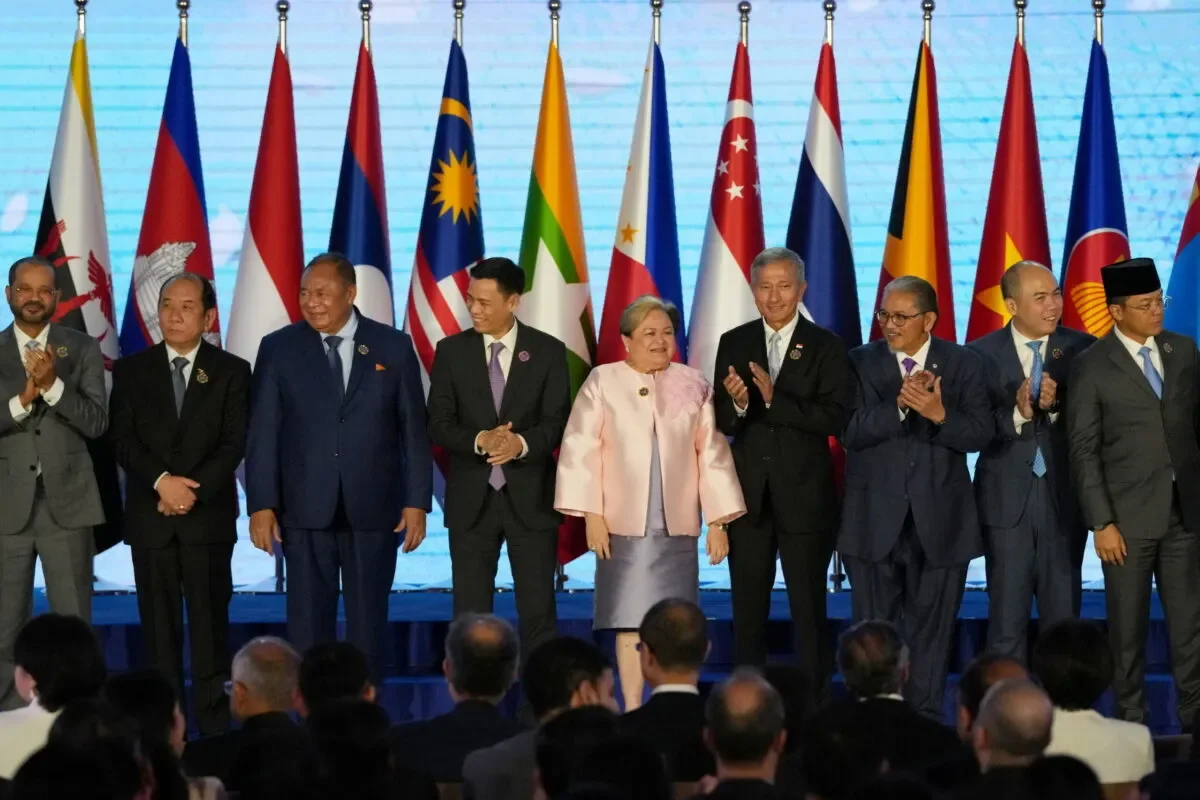
Philipines Foreign Secretary Theresa Lazaro and other leaders attend a group photo session during the High-Level Conference of the High Contracting Parties to the Treaty of Amity and Cooperation (TAC) on the sidelines of the Association of Southeast Asian Nations (ASEAN) Foreign Ministers’ Meeting in Pasay, Metro Manila, on July 24, 2026 | Photo via REUTERS/Aaron Favila
In an article for East Asia Forum, Shahar Hameiri, Lee Jones, Seth Schindler, and Jessica DiCarlo assert that in the midst of gobalization and the US-China rivalry, other nation-states have entered an era of polyalignment where states are pressured to react by engaging with multiple partners through diverse actors rather than choose between the US or China.
At the January 2026 World Economic Forum Annual Meeting, Canadian Prime Minister Mark Carney made headlines by openly acknowledging the demise of the ‘rules-based international order’. He urged ‘intermediate powers’ to work together to build institutions and interdependencies with like-minded countries. It is significant that a prominent Western leader made this argument, but Carney is late to the party. Amid intensifying US–China rivalry, many leaders have long been expressing similar views.
Former Senegalese president Macky Sall stated in September 2022 at the United Nations General Assembly that ‘Africa … does not want to be the breeding ground of a new Cold War, but rather a pole of stability and opportunity open to all its partners, on a mutually beneficial basis’. Indonesian President Prabowo Subianto concurred in May 2024, stating that ‘the fact that we are friends with [the United States, Japan, South Korea and Europe] doesn’t mean we can’t be friends with China, India, Russia’.
To some, these statements represent a modern version of non-alignment — a rationale outlined by former Indonesian president Sukarno at the Bandung Conference in 1955. As superpower rivalry intensified and the threat of nuclear war loomed, Sukarno urged newly independent African and Asian countries to remain independent from the hardening East–West blocs. He hoped that by keeping the great powers at arm’s length, non-aligned countries could maintain autonomy and act as a stabilising force in world politics.
But contemporary world leaders like Prabowo, Sall, Carney and many others do not truly want to keep the United States, China or other large powers and markets at arm’s length. Most countries have cultivated deep ties with diverse external partners over the past four decades of economic globalisation. They have no intention of severing these links. If they cut ties with either the United States or China — the two largest economies in the world — the harm to their own economies and societies would likely be intolerable and politically inconceivable.
In an August 2026 special issue of Third World Quarterly, we conceptualise this as ‘polyalignment’ — the cultivation and maintenance of engagements with multiple external partners and networks by diverse state and societal actors.