China, ASEAN Sign Enhanced Free Trade Pact amid Trump Tariffs
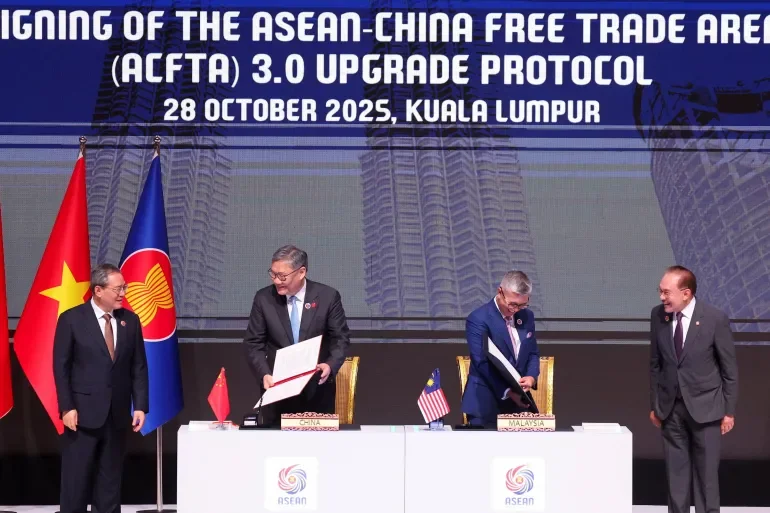
Malaysian Prime Minister Anwar Ibrahim and Chinese Premier Li Qiang witness the signing of the ASEAN-China Free Trade Area 3.0 Upgrade Protocol ahead of the 28th ASEAN–China summit, held as part of the 47th ASEAN summit in Kuala Lumpur, Malaysia, October 28, 2025 | Hasnoor Hussain/ Reuters
In an article for Al Jazeera, Erin Hale gives an overview of the upgraded ASEAN-China Free Trade Agreement, which will broaden collaboration on infrastructure, digital and green transitions, trade facilitation, and people to people exchanges, as trade between both parties grow under Trump's trade wars.
Kuala Lumpur, Malaysia – China and the Association of Southeast Asian Nations (ASEAN) have upgraded their free trade agreement as trade between the two regions continues to rise in the shadow of United States President Donald Trump’s trade war.
The trade pact was signed on the sidelines of the 47th ASEAN Summit in Kuala Lumpur on Tuesday, in a ceremony witnessed by Chinese Premier Li Qiang and Malaysian Prime Minister Anwar Ibrahim.
The “3.0 version” of the deal will broaden collaboration on “infrastructure, digital and green transition, trade facilitation and people-to-people exchanges”, according to China’s State Council. It builds on the region’s first free trade pact with China, which came into force in 2010.
The 11-member ASEAN and China have become each other’s largest trade partners in recent years, thanks to the China Plus One supply chain that emerged after Trump’s trade war with China in 2018.
Trade between China and ASEAN has already hit $785bn in the nine months of 2025, up 9.6 percent year-on-year. Much of this trade reflects integrated manufacturing supply chains, but it also increasingly includes finished goods from China that are destined for Southeast Asian consumers.