Call for Papers – Understanding the Southeast Asian (SEA) Games: Sport, Politics, Culture
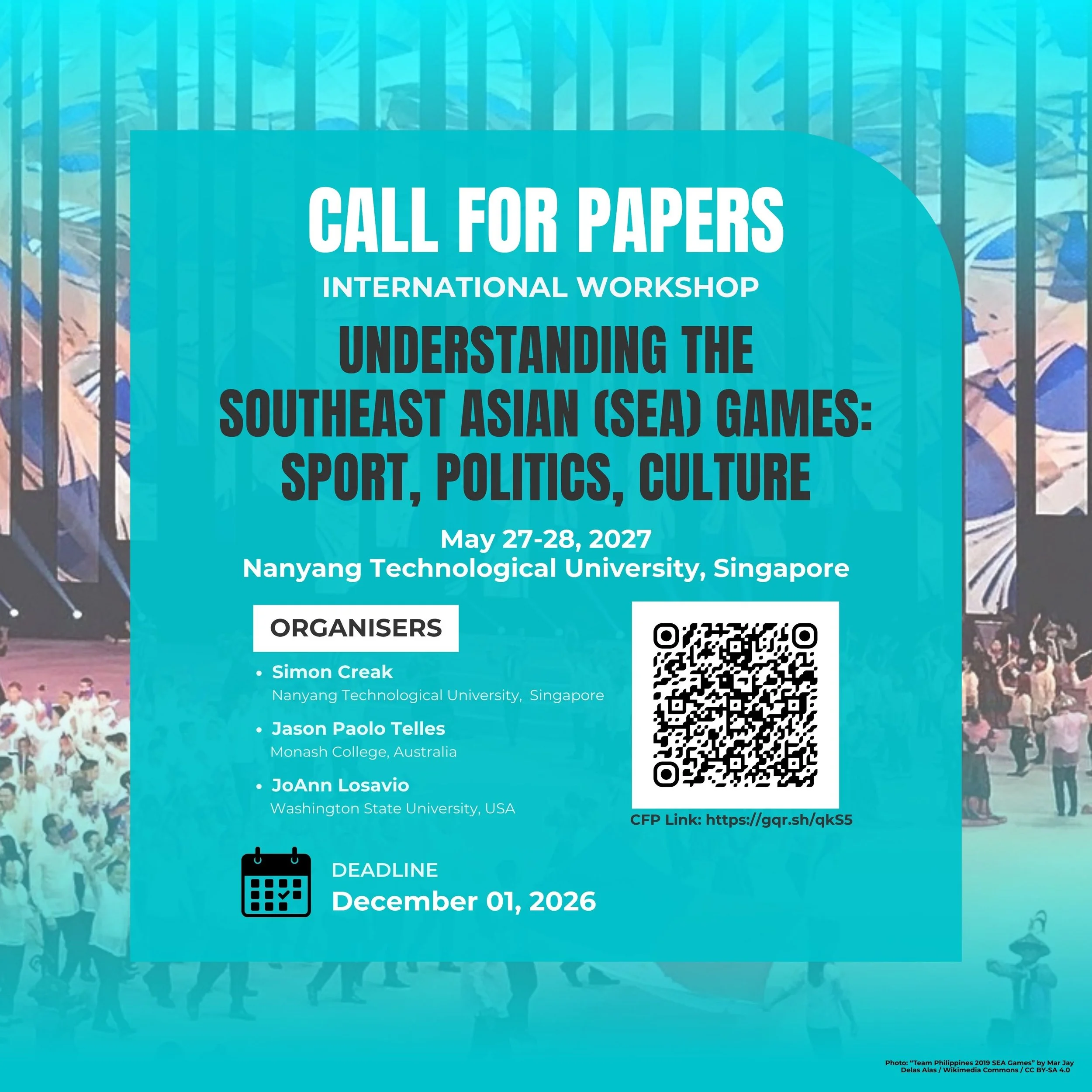
Understanding the Southeast Asian (SEA) Games: Sport, Politics, Culture
May 27 – 28, 2027
Nanyang Technological University, Singapore
FORMAT: In-person (online may be considered in exceptional circumstances)
CFP DEADLINE: December 1, 2026
ORGANISERS
Simon Creak, Nanyang Technological University, Singapore
Jason Paolo Telles, Monash College, Australia
JoAnn Losavio, Washington State University, USA
INTRODUCTION
Established in 1959 as the Southeast Asian Peninsular (SEAP) Games, the biennial Southeast Asian (SEA) Games, the region’s largest and most popular sports event, have developed in close relation to the political and social histories of postcolonial Southeast Asia. Successive editions have shaped and been shaped by state power and political leadership, diplomatic relations, national and regional identity formation, cultural representation, transformations in national media systems, urban development, transnational movement of athletes, sporting personnel and expertise, and changing environmental policies and practices associated with event hosting.
These conditions have informed the organisation, representation, experience, and social, political, cultural, and ideological meanings of the SEA Games in different historical periods and national contexts. Yet, despite increasing academic interest in the event, scholarship remains dispersed among studies of individual host countries, particular editions, specific sports, sports institutions, political controversies, cultural performances, and media representations. This workshop, and a planned edited volume arising from it, aims to bring these dispersed strands of scholarship into conversation by treating the SEA Games as a common object of regional inquiry.
The proposed book emerging from the workshop aims to be the first scholarly volume to present a collection of critical and interdisciplinary studies of the SEA Games using frameworks, approaches, and methods from the social sciences and humanities. Approaching the SEA Games from multiple perspectives, national, historical, institutional, cultural, and political, the volume will ask how the event has collectively been constituted, contested, and transformed as a Southeast Asian sporting institution and practice.
The proposed collection aims further to draw on Southeast Asian perspectives to contribute to (and complicate) the growing body of international scholarship on sport mega-events, including considerations of scale, visibility, hosting, political/social/cultural significance, and what gives an event its “mega” character. Likewise, the collection seeks to contribute to scholarship on sport history, nationalism, regionalism, diplomacy, governance, media, cultural representation, urban development, and postcolonial societies.
POSSIBLE THEMES
The workshop and edited collection adopt a critical approach to the SEA Games as a political, social, cultural, and communicative event. Contributions may draw from and contribute to theories, concepts, and methods from Southeast Asian studies, sport studies, media and communication studies, history, political science, sociology, anthropology, cultural studies, gender studies, and related fields and disciplines. Thematic areas of interest include, but are not limited to, the following:
1. Histories, politics, and governance
Formation and transformation of the SEAP/SEA Games since 1959
Decolonisation, the Cold War, and postcolonial state formation
ASEAN, regionalism, and changing interstate relations
State power, diplomacy, and political uses of the SEA Games
Gender, class, ethnicity and race, and environmental politics
Governance disputes, boycotts, corruption, and political crises
2. Nationhood, culture, and representation
National identity and regional belonging
Gender representations and participation
Sporting rivalries, victories, defeats, and national heroes
Cultural semiotics/representation of opening and closing ceremonies
Cultural heritage, ethnicity, religion, language, and locality (including local sports)
Cultural authority, authenticity, appropriation, inclusion, and exclusion
3. Media, communication, and public/popular culture
Journalism and media representation of the SEA Games
Broadcasting and changing media technologies
Digital platforms and athlete self-representation
Online nationalism, gender stereotyping, misinformation, censorship, and harassment
Fandom, humour, memes, public criticism, and collective memory
4. Athletes, identities, and transnational mobility
Athlete experiences and institutional authority
Gender, sexuality, disability, class, ethnicity, religion, and age
Youth development, education, celebrity, and social mobility
Migration, naturalisation, dual citizenship, and diaspora athletes
Foreign coaches, training networks, and regional sporting exchange
5. Hosting, infrastructure, labour, and environment
Host cities, venues, and infrastructure
Public expenditure, state-led development, and corruption issues
Displacement, security, and event labour
Post-event use, abandonment, and legacy of facilities
Environmental effects, sustainability claims, and environmental politics
PUBLICATION
NUS Press (Singapore) has expressed in-principle interest in publishing an edited volume on the workshop theme (subject to contract and peer review processes).
FLIGHTS AND ACCOMMODATION
Workshop participants from outside Singapore will receive a return airfare and hotel accommodation for the duration of the workshop (capped at one person per paper).
KEY DATES
Abstract due date: 1 December 2026
Notification of outcome: late December 2026
Draft chapter submission (4,000-5,000 words): 1 May 2027
Workshop: 27-28 May 2027
Revised chapter submission: Sept-Oct 2027
Target publication date: late 2028 or 2029
ENQUIRIES
JoAnn LoSavio joann.losavio@wsu.edu
Jason Paolo Telles jason.telles@monashcollege.edu.au
Simon Creak simon.creak@nie.edu.sg
GENERATIVE AI POLICY
The workshop organisers value principles of academic integrity, including human scholarship, authorship and voice. Abstracts that appear to be wholly or substantially produced by generative AI will not be considered. (Submissions with grammatical errors and stylistic infelicities will receive full consideration).
ABSTRACT SUBMISSION
Please lodge abstracts via this Google form: https://forms.gle/GKEJoKScDEhrAzcb9
Please note: As the workshop papers will subsequently be published in an edited collection (subject to peer review), paper/abstract submissions must not have been published previously (or forthcoming) elsewhere.
Source: https://gqr.sh/qkS5