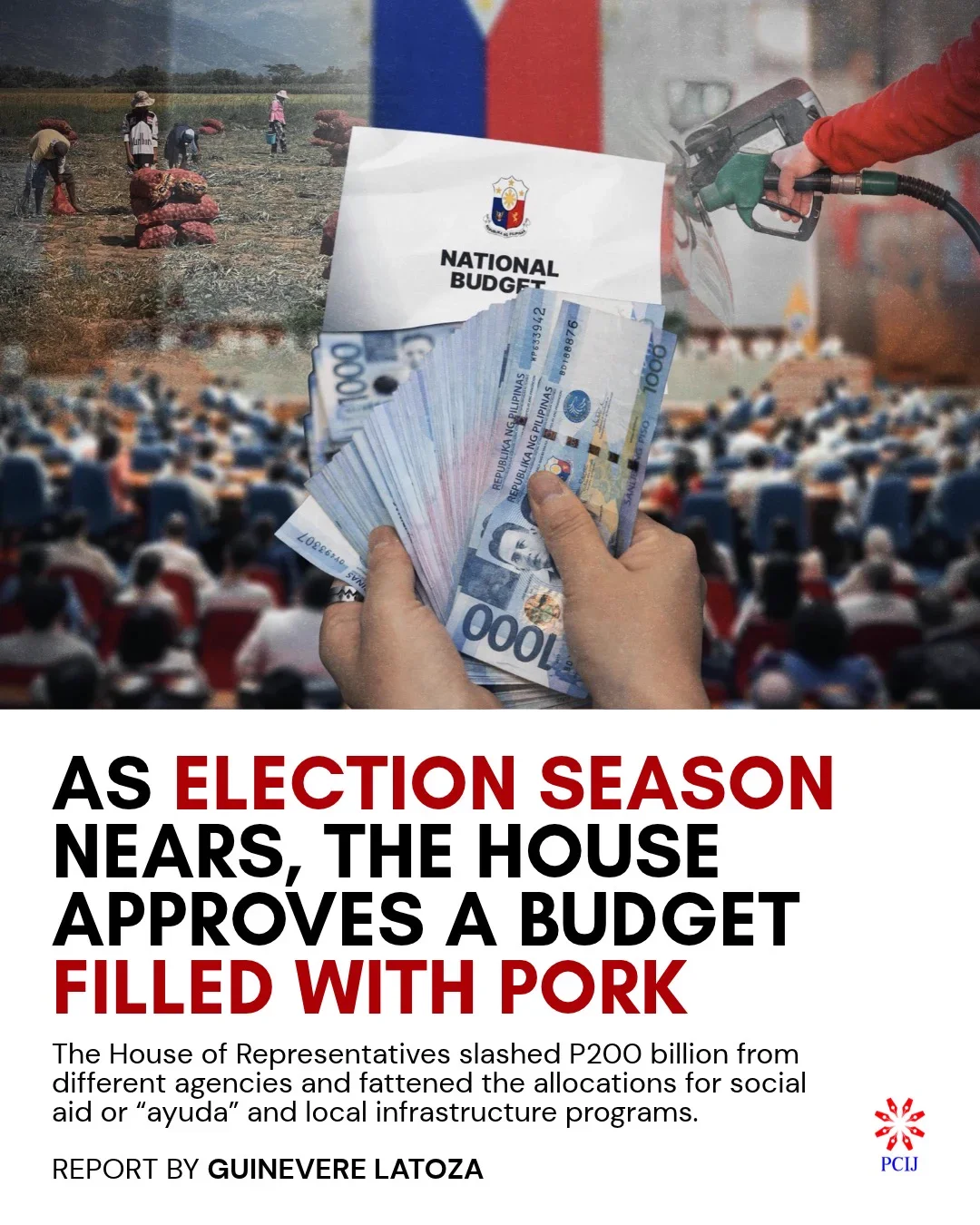
n an article for the Philippine Center for Investigative Journalism (PCIJ), Guinevere Latoza and the PCIJ research team found that the Philippine House of Representatives fattened the allocations for social aid and local infrastructure programs using funds referred to as “soft pork” and “hard pork” as Congress can direct them to favored projects or constituents.
Since the House of Representatives passed its version of the proposed P7.2-trillion budget for 2027 on Oct. 12, budget reform advocates have raised alarm over billions worth of dubious pork barrel allocations that were inserted by lawmakers. Only 13 of 318 members dissented.
Our analysis showed that the House fattened the allocations for social aid or “ayuda” and local infrastructure programs. Critics have called these funds “soft” and “hard pork” because members of Congress can direct these funds to favored projects or constituents. Presidential son Rep. Sandro Marcos’ Ilocos Norte 1st District is the top recipient of hard pork, with the House giving his district an additional P4.4 billion of infrastructure projects on top of the P369 million originally allocated for it in the budget of the public works department.
To give way to these additions, the House slashed P200 billion from foreign-assisted projects, pension funds, the calamity fund, education and health programs, and other proposals from different agencies.
The House can’t increase the budget as stated in the 1987 Constitution and affirmed by the Supreme Court in its recent ruling on unprogrammed appropriations. But it can realign the items proposed by the executive. Its “habit” of slashing funds for foreign-assisted projects, said former budget secretary Florencio “Butch” Abad, has allowed lawmakers to free up space in the budget to insert local projects and “assorted assistance” programs that are “faster to announce, easier to control, politically more rewarding, and vulnerable to abuse.”