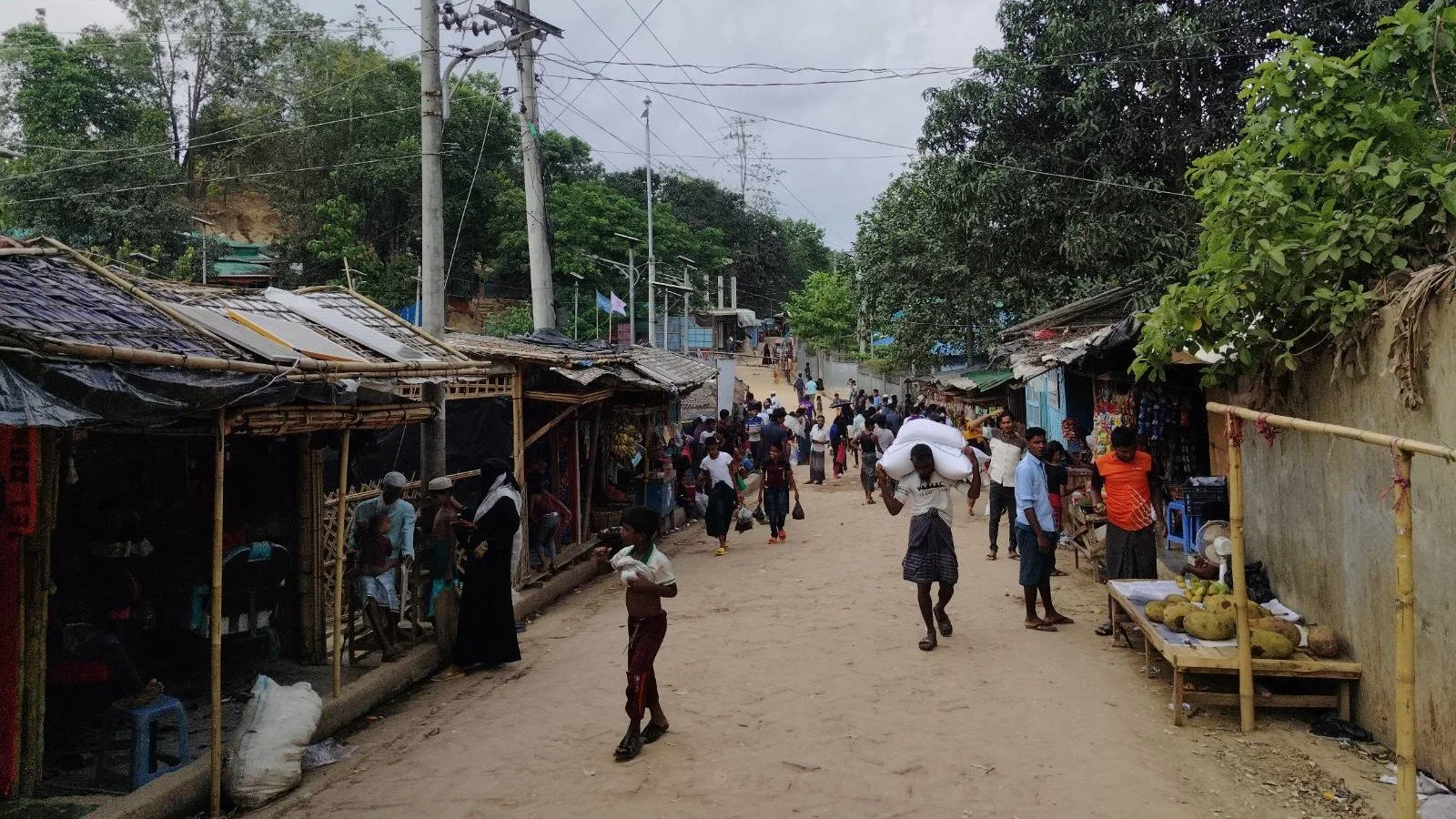
Rohingya refugees carry monthly rations along the road after food assistance was reduced to $7, in the Cox’s Bazar Rohingya refugee camp in Bangladesh on May 19, 2026 | Niyamot Ullah/Mekong Independent/Creative Commons
In an article for Mekong Independent, Niyamot Ullah writes about the conditions of Rohingya refugees Bangladesh as their refugee aid has been reduced to only $7 per person per month.
Abdu Shukkur’s monthly supply of rice, lentils and eggs ran out after only 18 days. Only half a liter of oil remained, and some garlic for a Sunday meal for his eight children. There were no edible goods remaining except an empty container.
Inside the crowded Rohingya refugee camps of Cox’s Bazar in Bangladesh, hunger does not arrive all at once. It comes slowly, meal by meal, item by item, until families begin calculating how many days remain before the next food distribution.
“The children ask for food many times,” Abdu Shukkur said, sitting inside his bamboo shelter as rain dripped through the poor plastic roofing above him. “Sometimes we tell them to sleep early so they do not feel hungry.”
Like more than 1.2 million Rohingya refugees living in Bangladesh, Abdu Shukkur fled genocidal violence and mass displacement in Myanmar. Most families survive entirely through humanitarian assistance.
In April, the World Food Programme (WFP) introduced a new three-tier assistance system based on household vulnerability. Under the system, around 17 percent of refugees receive food assistance worth $7 per person per month, while others receive either $10 or $12. Prior to the change, all the families received $12. According to WFP, “male-headed households with able-bodied men” are placed in the $7 tier, with the implicit assumption being that people who can do physical work need lesser aid. However, refugees inside the camps are restricted from formal employment and have no opportunities to earn income legally.